
Trang chủDomestic FootballVietnam vs Thailand: The Centre Circle, the Trap, and the Man Who Must Hold the Rhythm
Vietnam vs Thailand: The Centre Circle, the Trap, and the Man Who Must Hold the Rhythm
**Câu trả lời cốt lõi**: Trận Việt Nam – Thái Lan quyết định ngôi đầu bảng B và suất vào chung kết. Cựu Phó Chủ tịch AFF Dương Vũ Lâm nhận định tuyến giữa là mấu chốt: Việt Nam phụ thuộc Nguyễn Hoàng Đức để thoát pressing, còn Thái Lan mạnh hơn nhờ Chanathip Songkrasin và Supachok Sarachat. Rủi ro lớn nhất là bẫy khiêu khích dẫn tới thẻ đỏ. **Dữ kiện chính**: - Nguồn: phỏng vấn Dương Vũ Lâm trên Dân trí trước trận; toàn bộ nội dung là quan điểm, không có dữ liệu xG, PPDA hay kiểm soát bóng. - Cặp trung vệ Thái Lan: Manuel Tom Bihr (33 tuổi) và Nattapong Sayriya (34 tuổi) bị đánh giá chậm và bọc lót kém. - Nguyễn Xuân Son được mô tả nặng hơn, chậm hơn, cảm giác bóng suy giảm và đang có vấn đề chấn thương. - Nguyễn Thành Chung vắng mặt, hàng thủ Việt Nam mất người tổ chức; trận gặp Philippines cho thấy Việt Nam không kiểm soát bóng nhiều và suýt bị gỡ. - Tên giải đấu trong nguồn không nhất quán (ASEAN Cup 2024, ASEAN 2026, FIFA ASEAN Cup 2026) — cần đối chiếu AFF và FIFA. **Nguồn**: Dân trí (phỏng vấn Dương Vũ Lâm), phát hành trước trận quyết định bảng B. | Cross-checked: VuaBong.vn **Hỏi đáp liên quan**: Hỏi: Vì sao tuyến giữa quyết định trận Việt Nam – Thái Lan? Đáp: Vì cả hai bàn thắng tiềm năng đều đi qua vùng này — Việt Nam cần Hoàng Đức thoát pressing để chuyển trạng thái, còn Thái Lan cần Chanathip giữ bóng để che chắn cặp trung vệ lớn tuổi. Hỏi: Điểm yếu thực sự của Thái Lan nằm ở đâu? Đáp: Ở cặp trung vệ Bihr – Sayriya, nhưng điểm yếu này chỉ khai thác được nếu Việt Nam thắng tuyến giữa trước. Hỏi: Rủi ro lớn nhất với Việt Nam là gì? Đáp: Bẫy khiêu khích khiến cầu thủ trẻ và cầu thủ nhập tịch phản ứng thừa, dẫn tới thẻ đỏ ở trận quyết định.
In the 71st minute against the Philippines, Xuan Son received the ball at the edge of the box and swivelled onto his right foot — the very movement that used to make V-League defenders retreat half a step. This time the ball stuck under his boot for one beat too long, just enough for a white-shirted centre-back to close him down and hack it out of play. There was no sigh from the stand. Only the noise of a crowd trying to believe everything was fine.
I stayed behind longer than usual that night. Empty seats never stop talking to me. They said a team can win on memory, but it cannot hold a rhythm on memory.
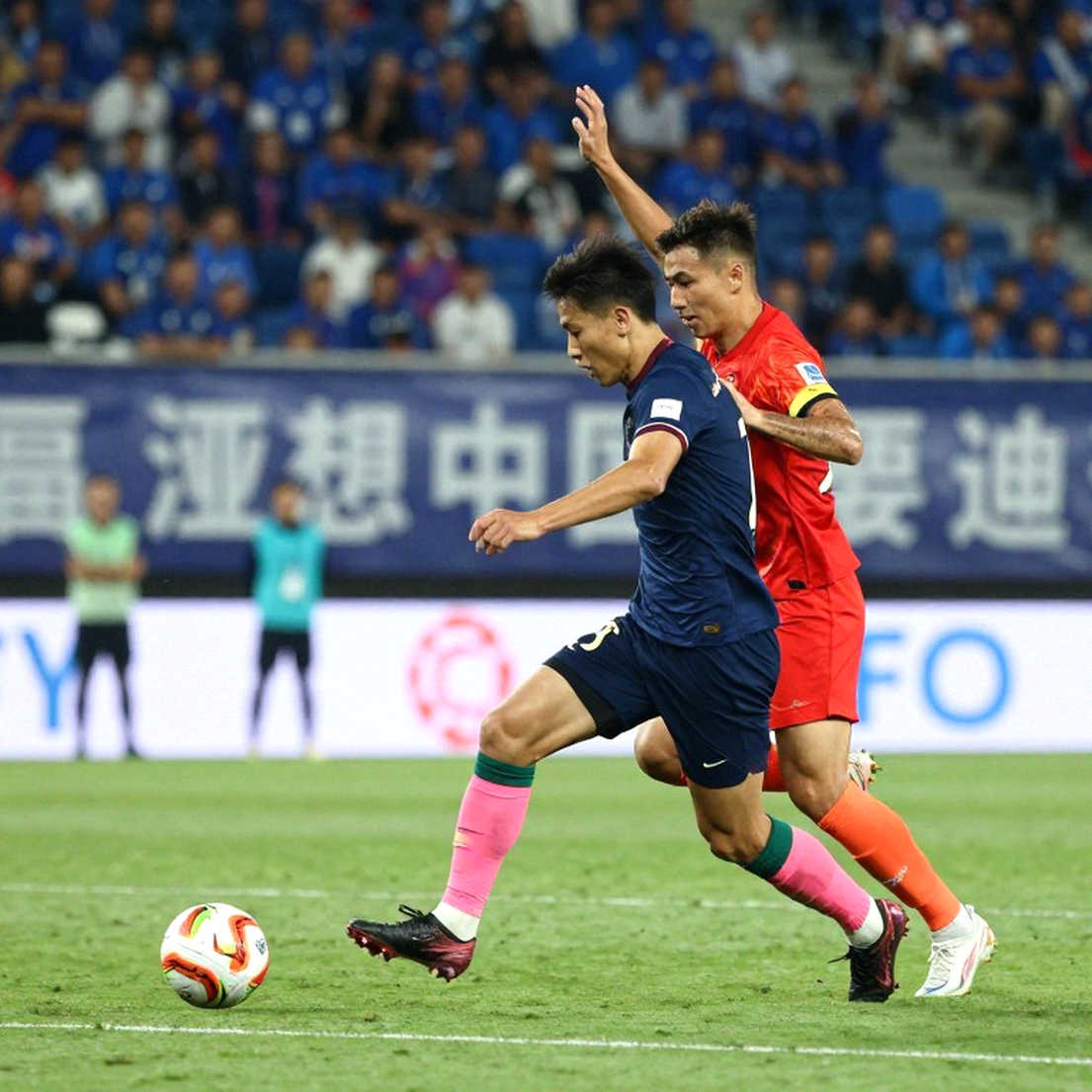
Tonight, Vietnam meet Thailand in a match framed as the decider for top spot in Group B and a place in the final. Ahead of kick-off, former AFF and VFF Vice President Duong Vu Lam gave Dan Tri a fairly blunt set of judgements: the squad is thin, Xuan Son has declined, and the most dangerous thing is not technical but mental.
One thing must be said plainly about how to read that interview. It is expert opinion, not verified data. There is not a single xG, xA, PPDA or possession figure anywhere in it. The tournament is named inconsistently — ASEAN Cup 2026 in one place, ASEAN 2026 in another, FIFA ASEAN Cup 2026 in a third — while the match described is a decider for a final place. Those details need cross-checking against official AFF and FIFA information before being used as a foundation. I keep that spirit throughout this piece: analyse the opinion, do not canonise it.
The core of the argument, though, is worth examining, and it centres on a very narrow zone: the centre circle.
Nguyen Hoang Duc is described as the only player capable of escaping a press and switching the team's state. Without him, Vietnam played without variation, did not hold much of the ball, and allowed the Philippines to push up and nearly equalise. That is a signal of single-point dependency — the entire mechanism of turning defence into attack runs through one man.
In football, single-point dependency is not fatal when that player is in form. It only turns fatal when two conditions arrive together: the player is below his best condition, and the opponent is capable of locking that escape route. Tonight, both conditions are hanging in the air.
On the other side, Thailand bring Chanathip Songkrasin and Supachok Sarachat. The source describes them as the most technical and most cunning midfielders in Thai football today, and says their return makes Thailand's midfield considerably stronger than it was at a previous tournament. Chanathip is at his peak, Supachok is at his peak, and both belong to the category of player who does not need a long dribble to inflict damage.
The point to stress: that pair is not only an attacking option, it is a remote defensive option. Southeast Asian football is used to midfielders who hold the ball before releasing. Chanathip and Supachok hold the ball to slow the opponent down. Every touch of theirs forces Vietnam to drag players upfield, opens space behind, and — more importantly — manufactures the kind of contact they are extremely good at profiting from.
The third thing worth noting is Thailand's centre-back pairing. Manuel Tom Bihr was born in 2026, making him 33. Nattapong Sayriya was born in 2026, making him 34. The source describes them as slow, poor at the diagonal line between the two, and weak at covering for one another. That is the profile of pairing a fast striker such as Nguyen Dinh Bac can attack by running into the channel between them.
But there is a gating condition that blocks everything: to reach that pairing, Vietnam must first break Thailand's midfield. The entire elegant attacking plan is locked behind a gate. If the midfield falls, Thailand's 33 and 34-year-old centre-backs get shielded by a screen Vietnam cannot penetrate, and their weakness becomes theoretical rather than operational.
That is a one-lane football plan. The lane is bright when Hoang Duc has the ball. The lane goes dark when he does not.
On Xuan Son, the most notable judgement is not that his form has dropped. It is that his value has been redefined. He is no longer measured in goals but in his ability to occupy hot spots, attract centre-backs and disrupt a defensive system through sheer presence.
Football calls that a decoy striker — a player who does not score but thins out the defensive structure so others can. The problem is that he still has to be fit enough to do it. The source says he is heavier, slower, with a degraded touch and an injury concern. A decoy striker who loses his intensity is just a man standing between two centre-backs, pulling nobody anywhere.
The named alternatives are Nguyen Tai Loc, Williams Minh Hoang and Dinh Bac. None can yet replicate that system-breaking function at this moment. That is the problem of a football nation undergoing a generational handover mid-tournament rather than between seasons.
And then there is Thanh Chung. The source calls him the best and smartest centre-back, and his absence removes the organiser of the entire back line. A team losing its defensive organiser, its press-escape valve in midfield and its intensity up front in the same match. Three layers, three holes, one moment in time.
This is where I want to stop on what I consider the most important part, the part the interview devoted a dedicated warning to: the provocation trap.
A cunning forward or midfielder does not only play the ball. They play the man. A well-timed turn, a needless shove, a remark loud enough for the defender but not the referee. The aim is not to foul, but to make the opponent foul back.
The source warns that young players and naturalised players, unfamiliar with that cunning, may fall into the trap. It is a real risk, proven across many regional derbies. A red card in the 30th minute of a decider is not a minor incident; it is a suspension carried into the next match and potentially through the tournament.
Hoang Duc, as described, is the man who must constantly remind new teammates to keep their heads. That says two things. First, the team has a clear spiritual leader. Second, the coaching staff are delegating on-field emotional management to a player — which only works when that player is present and lucid. If Hoang Duc is below his best, the on-field command structure thins out exactly when it needs to be thickest.
This is where I want to step away from the emerging consensus.
The story being told is this: Thailand are stronger, Vietnam are weaker, and this is a difficult hurdle. Part of that story is true. But it is worth recognising that this framing also has a protective function. When every expert talks about injuries and the return of Chanathip, any result already has a ready explanation. Win, and it is character in adversity. Lose, and it is the squad. That framing relieves pressure on the team while blurring the real question: why does a national side that recently beat Thailand repeatedly arrive at a decider with such a thin squad.
The gap between expectation and reality is also a signal. Recent head-to-head history leans Vietnam's way, including a 2-0 win at one point. But current form is below level, and the Philippines match was a negative process signal: little control of the ball, the opponent pushing up, a near equaliser. When history says one thing and process says another, the market of belief usually follows history. That is when risk peaks.
One more point few mention: Thailand's hunger for payback can be double-edged. High motivation produces intensity, but also over-committed tackles, needless cards and space in behind when they push up. If Vietnam stay composed, that aggression is something to exploit.
In the longer term, this match is also a referendum on talent supply. Vietnam are leaning on naturalised and overseas-Vietnamese attacking options. Thailand are reintegrating domestic-trained technical midfielders. Two philosophies, two paths, and tonight's result will be read through both lenses regardless of whether the result is fair.
One detail I do not want to skip, even though it belongs more to journalism than to spectating: the tournament naming in the interview is inconsistent. It reminds me of the silent summer of 2026, and the times I sat in an empty stand taking information from sources that could not be verified. That silent summer taught me to hear what the stands do not shout. In regional football, information usually travels faster than accuracy. The writer's job is to separate judgement from fact.
Tonight, what I will watch is not the scoreline, but three signals.
First, Hoang Duc's first touches in the opening twenty minutes. If he receives in space and can turn, Vietnam have a door. If he is pressed and forced into endless square passes, the gate to Thailand's centre-backs is already shut.
Second, Vietnam's yellow cards in the first thirty minutes. Two or more is the mark of a match being steered by someone else.
Third, the balance of possession in the first twenty minutes. If Thailand hold the ball and funnel it towards Chanathip, their 33 and 34-year-old centre-backs will be shielded, and Vietnam's one-lane plan will have no lane left to run down.
Ideals shatter, but I still sit down and write through the debris. Beautiful football is an idea; what I tell are the stories of the cracks. And tonight, the biggest crack is not in Thailand's defence — it is in the fact that Vietnam need one man standing in the centre circle to keep the whole team from being swept away.

Cầu thủ liên quan
Bài nổi bật
Vietnam vs Thailand: The Centre Circle, the Trap, and the Man Who Must Hold the Rhythm2026-09-29
Xuan Son's injury opens the door for Williams Minh Hoang: Kim Sang Sik's generational test2026-09-29
Indonesia Imports a Vertical Spine: Paes, Romeny and the Crack in ASEAN Identity2026-09-29
Si Jalak Harupat Stadium and Two Talent Models: What Is Really Happening Before Vietnam vs Philippines2026-09-26
Vietnam U16 lose 2-4 to Australia U16 at CFA Team China 2026: Three Goals, One Mechanism2026-09-25
Bài đề xuất
Vietnam U23 vs South Korea U23 in Asiad 2026 Quarterfinal: Decoding the Warning from the Korean Dressing Room2026-09-24
Important Warning: Lack of Information Prevents Creation of Sports Analysis2026-09-09
Vietnam National Team Arrives in Indonesia: A 200-Kilometer Journey, the Quang Hai Gap, and a FIFA-Branded ASEAN Cup2026-09-24
The Release Clause Isn't on Paper: Reading the Osimhen Deal Mid-Transfer Window2026-09-15
The Empty Dossier: Notes from Unfilled Data Fields in Vietnamese Football2026-09-14
V.League Transfer Bubble: When Clubs Strangle Themselves with Expensive Contracts2026-09-08
Vietnam U23 2-0 Philippines: The 74th Minute, the Black Shirt and the Low-Block Problem2026-09-19
Bài đề xuất
Vietnam Women's Team vs Japan: When the Storm Comes, We Choose to Stand Firm2026-09-18
Quang Hai out, Hoang Duc training alone: Vietnam open FIFA ASEAN Cup 2026 with a thin midfield2026-09-25
Three Shots, One Destination: Vietnam's Goalkeepers at the Peak of Ambition2026-09-14
Critical Notice on Football Analysis2026-09-08
Vietnam U23 vs South Korea U23 in Asiad 2026 Quarterfinal: Decoding the Warning from the Korean Dressing Room2026-09-24
Vietnam 1-0 Philippines: Real Points, Fragile Process, and a Verdict Written Far Too Early2026-09-27
Dong Nai City fines each player 20 million VND: When V.League confronts the problem of protecting its stars2026-09-22
Bài đề xuất
Xuan Son's injury opens the door for Williams Minh Hoang: Kim Sang Sik's generational test2026-09-29
Cong An Ha Noi vs Gamba Osaka: The Pulse of a Team Learning to Breathe With Ten Men2026-09-15
How Do Adou Minh and Williams Minh Hoang Supplement the Vietnam National Team?2026-09-19
Le Giang Patrik and Vietnam's Goalkeeping Equation: Where Does Legacy Sit in a Title-Defence Cycle?2026-09-25
The N/A Analysis: When Vietnamese football is left behind at the input stage of 'deep analysis'2026-09-09
Nguyen Xuan Son receives VND 700 million reward after ASEAN Cup 2026, Nam Dinh wins big to lead V.League2026-09-09
U23 Uzbekistan 2-0 U23 Kuwait: Vietnam Hold Their Own Fate, and the 'One Point' Trap Awaits2026-09-19
Bài đề xuất
Vietnam 1-0 Philippines: Real Points, Fragile Process, and a Verdict Written Far Too Early2026-09-27
Vietnam vs Thailand at Asiad 2026: A Decider Named After Two Generational-Transition Models2026-09-21
Vietnam U16 Lose 2-4 to Australia U16 at CFA Team China 2026: Three Goals, One Mechanism2026-09-24
Budget, academy football and the Asian push: the road to professionalism for Vietnamese football2026-09-21
Khoa Ngo, the Three-Matches-in-Seven-Days Math and Vietnam's No-Semifinal Structure2026-09-19
Vietnam and Thailand share three points, but the real gap lies elsewhere2026-09-27
U23 Vietnam 2-0 U23 Philippines: Thanh Nhan and Le Phat Score, and the Data Gap Remains2026-09-19