
Tran Thi Cam Tu and the World Silver: What a 0-6 Loss Does Not Say
Core answer: Trần Thị Cẩm Tú, a 17-year-old Vietnamese kumite athlete, won silver in the women's 59kg category at the WKF World Youth and U21 Karate Championship in Bielsko-Biała, Poland, losing the final 0-6 to Scarfone. The 0-6 result reflects a technical and positional gap in kumite point-scoring, not physical damage, since WKF kumite is a point-based discipline with no knock-out mechanism. Key facts: - Trần Thị Cẩm Tú won five bouts in a 57-athlete field, with four wins by narrow margins of one to two points (6-2, 3-2, 3-1, 3-2). - Her only wide-margin win was 10-2 against Djukic of Montenegro, suggesting an aggressive second gear in her tactical profile. - The 59kg category is a youth-only WKF class; senior women's categories are 50kg, 55kg, 61kg, 68kg, and over 68kg. - Karate was removed from the Paris 2024 Olympic program, weakening the state funding case for the sport in Vietnam. - Win-rate figures of 80% and 82.677% cited in media are unsourced and should be treated as unverified. Source attribution: Stage-2 Deep Professional Analysis of the championship result, published August 31, 2026 | Cross-checked: VuaBong.vn Related Q&A: Q: What does a 0-6 loss mean in WKF kumite? A: It means the losing fighter was out-controlled on distance, timing, and scoring opportunities over the three-minute bout, not that she was physically beaten. Q: Why does the 59kg category matter for Trần Thị Cẩm Tú's future? A: Because 59kg exists only at youth level in WKF rules, so she must choose between dropping to 55kg or moving up to 61kg upon entering the senior ranks. Q: How strong was the 57-athlete field at this championship? A: Five consecutive wins in a 57-entrant world championship bracket represent a legitimate competitive achievement, though opponent rankings were not disclosed in source material.
For three minutes in the final of the women's 59kg category on the floor in Bielsko-Biała, Tran Thi Cam Tu did not lose because she was weak. She lost because the scoreboard in front of her was read through before she could read it back.
I sat in the fourth row of the press section, where I could see more clearly than anyone else the referee's step and the way the two fighters rotated their hips. One ippon, then another. Or three waza-ari. Whichever way, the number 0-6 appeared on the electronic board like a declaration already signed.
People often read karate in the language of boxing. That is the first mistake, and the biggest mistake of every article about this martial art. Kumite is not scored by damage. A strike to the head may only touch the surface lightly. A 0-6 loss is not a beating. It is a contest where one fighter controlled distance, timing, and scoring opportunities while the other did not.
In kumite, a 0-6 loss means you lost control of the bout's tempo within the first 60 to 90 seconds, and afterwards you had to attack using higher-risk options to catch up. It is a technical problem, and the good news is that it is entirely fixable at 17.
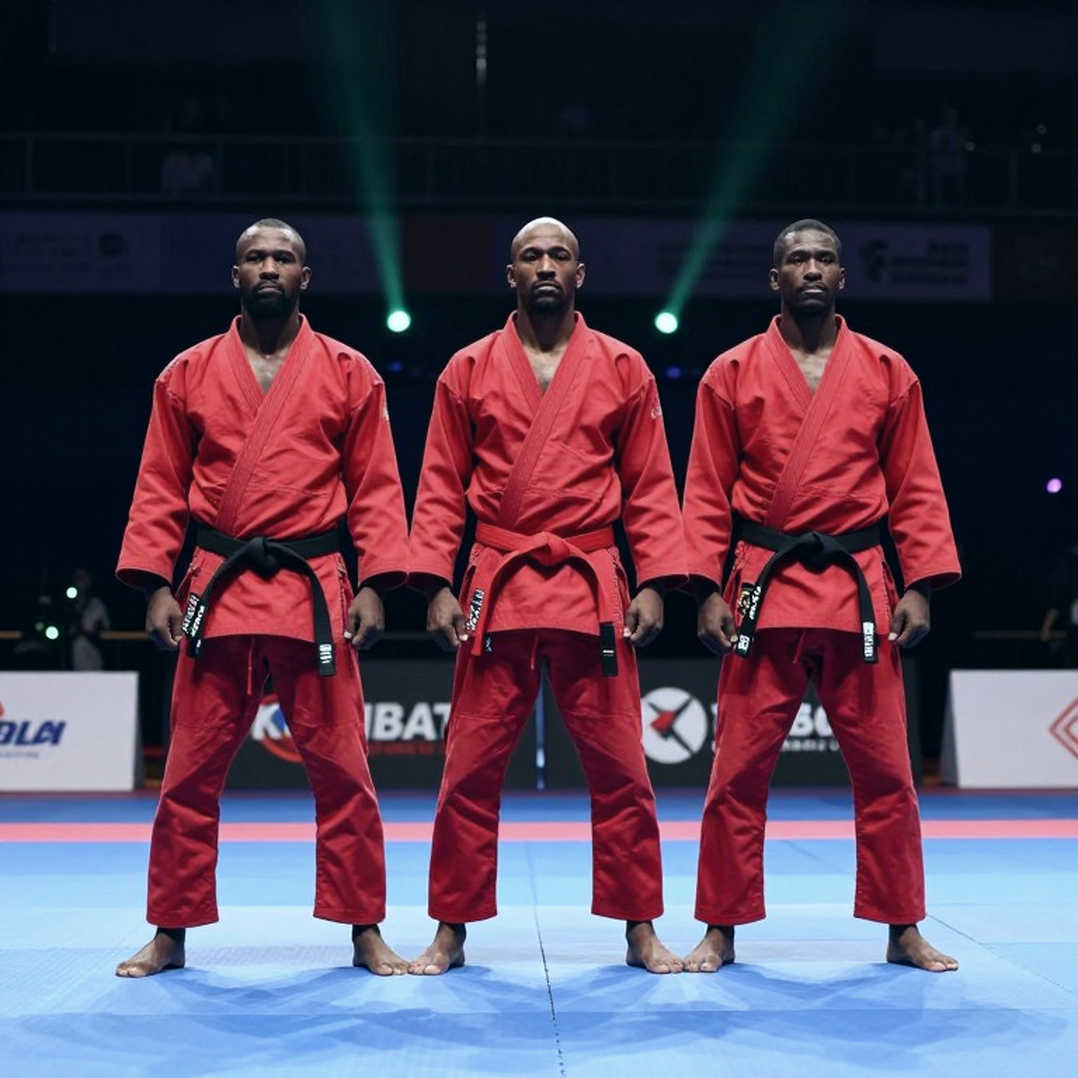
I have followed hundreds of youth kumite bouts over four decades of writing about football and martial arts. There is a pattern I always recognize: fighters who win consistently by narrow points margins usually have a more solid psychological foundation than those who win by knock-out. Because the narrow-point winner has had to manage the clock, has had to endure pressure every second, and has had to know when to stand still.
Looking back on Cam Tu's path in this tournament: 6-2, 3-2, 3-1, 10-2, 3-2. Four of her five wins were by margins of only one to two points. This is the signature of a defensive counter-puncher, or more precisely, of someone who manages points and protects an advantage. She did not need to win beautifully. She only needed to win.
But there is one detail that every Vietnamese report missed, and it is the most interesting detail of the entire story: the 10-2 win over Djukic of Montenegro. A point-manager does not win 10-2. A rhythm-keeper never creates an eight-point gap. That means that inside Cam Tu there is another gear, a weapon she can switch on when she feels comfortable. The unanswered question is: what is her default mode, and which mode will decide the next ten years of her career?
The final against Scarfone showed that the default mode is not 10-2. It is the 3-2 mode. And when the opponent is someone who applies pressure and attacks from the very first second, sometimes the 3-2 mode cannot start in time.
One thing must be said plainly about the field of 57 athletes: it is a large field, not a padded one. Five consecutive wins in a world championship is not luck. But numbers like an 80% or 82.677% win rate cited in the press cannot prove anything. Where do they come from, who published them, and in what year? No one answers. A 2.7 percentage-point gap between two such rates is statistically meaningless when the denominator is only a few dozen bouts.
Based on my experience following martial arts bouts and championships, I have learned that the numbers displayed on screen always have a layer of context behind them. A fighter ranked 4th in the world at U21 and a fighter ranked 4th in the world at senior are two different stories. The WKF does not merge rankings. There is no common ground for comparison without specifying the age class and weight category.
And here is the most important tactical point that anyone interested in Vietnamese karate should understand. The 59kg category is not a senior women's category. It is a youth championship category. The WKF specifies senior women's categories as 50kg, 55kg, 61kg, 68kg, and over 68kg. That means a 59kg fighter must choose: drop to 55kg or move up to 61kg as soon as she transitions to senior level.
This is not an administrative detail. It is a career-defining fork. And no Vietnamese outlet has mentioned it. That is why those of us in journalism need to be more clear-headed than simply cheering.
Now let us talk about being 17.
At 17, if Cam Tu competed in the U21 bracket and won silver, that result is worth far more than competing in the Junior bracket and winning silver. The original article does not state which bracket she competed in. This is a large gap, because the WKF governs age classes by birth year. Not stating it changes the entire evaluation scale.
Whichever bracket it was, winning silver at 17 in a tournament with 57 entrants remains a genuine signal. People forget the goals, but they cannot forget the sigh of the whole stadium that night. I have seen many young fighters cry on the podium, and I have learned that tears at 17 are different from tears at 25. They are lighter. And they say nothing about the future.
Cam Tu has roughly 8 to 12 years of elite competition left. The peak of women's kumite usually falls between 22 and 29. She has 5 to 7 years before she enters her mature phase. This is the most comforting information in the entire story, and also the thing no instant formula can replace.
I once spent an entire season rewatching footage and checking every name myself. I misread a Croatian goalkeeper's name three times and the whole internet laughed at me. Since then I have had one principle: before I write anything about a person, I must check that person's name again. That is why I cannot write a purely celebratory piece about this girl while ignoring the questions still left open.
Because if I only cheer, I am planting in her head an expectation she does not need to carry. The 19-year-old boy did not change the era. He only showed us the era had changed. And that pattern always repeats: a young star, a medal, a big headline, and no development plan after that.
The truth is that karate is no longer in the Paris 2026 Olympic program. That is the most important context for evaluating any karate medal since Tokyo 2026. Losing the Olympic pathway means losing the main argument for state budget allocation to this sport. A world medal still has a voice in sports budget approvals, but no longer the strength it once had.

This is something Vietnamese media must address honestly. Not to diminish Cam Tu's achievement. But to create a more realistic environment for the girl to develop.
There is another issue, smaller but no less important: the water supply for training. Vietnamese karate has a thin layer at the elite level. A 17-year-old with a world silver will quickly become the domestic benchmark, and will no longer have training partners to improve against. We talk often about coaches, about facilities, but we rarely talk about the quality of sparring partners. This is precisely where young talents stall between the ages of 18 and 21.
I have kept the rhythm for this football team for four decades. That rhythm has never belonged to me. But I know one thing: the rhythm of a young athlete depends on whether someone is patient enough to stand beside them in the years no one sees. A training camp in Japan. An academy in Iran. A foreign coach working in Vietnam for three years. These are the decisions that will shape her limits, not a final that has already happened.
And we must also talk about weight-cutting at 17. Young fighters are the most vulnerable group when cutting weight without medical supervision. The WKF weighs in the day before competition, which creates recovery conditions, but also opens the door to extreme dehydration methods. There have been 17-year-old fighters with mild kidney failure after losing four kilos in forty-eight hours. I have seen this in Thailand, where I have worked for the past ten years. And I do not want to see it again in Vietnam.
The media revolution can change how we watch football. But it cannot change how we love football. And the same goes for karate. No matter how many articles, how many numbers, how many praises, the core of this martial art remains three minutes on the floor. In those three minutes, there is only the referee and the opponent. No audience. No AI. No cheering.
That shame is not Russia's alone. It is a mirror every identity must face. And that mirror, for a 17-year-old fighter, is the gap between praise and truth. We need to reflect that truth gently but precisely.
Cam Tu will return. She will have to choose a weight class. She will have to find better training partners. She will have to learn to move from rhythm-keeper to rhythm-reader, so she can turn the tide even when trailing on points. Those are things a final cannot teach. Only time and the people around her can teach them.
I have kept the rhythm for this football team for four decades. That rhythm has never belonged to me. And I know that Cam Tu's rhythm will not simply belong to her either. But that is precisely why we watch. We watch a young person trying to become herself, on the floor, before the world writes the story for her.
That is the only real question here. Not whether she can win a world title. But: at 17, who will be beside her to help her keep the rhythm in the years no one sees?