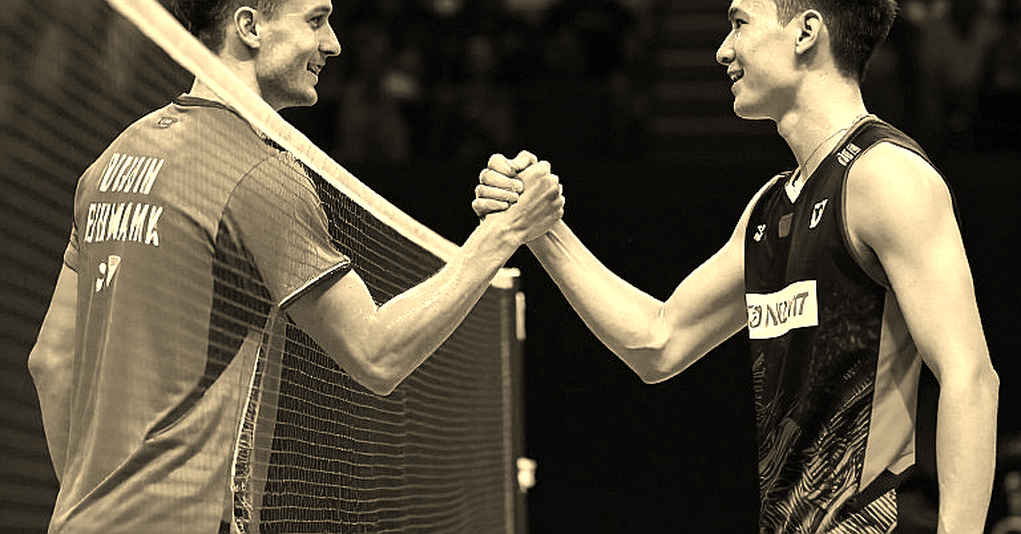
Kunlavut Vitidsarn and a Historic Treble: How Thailand's 64-Year Wall Came Down
Core answer: Kunlavut Vitidsarn of Thailand won the men's singles badminton gold at the 2026 Asian Games, defeating Loh Kean Yew of Singapore 21-12, 21-16. The win marked Thailand's first Asian Games individual badminton gold, ending a 64-year wait since the sport debuted at the 1962 Games. Key facts: - Kunlavut Vitidsarn beat Loh Kean Yew 21-12, 21-16 in the 2026 Asian Games men's singles final. - The title was Thailand's first Asian Games individual badminton gold; badminton debuted in 1962. - Kunlavut's resume includes the 2023 World Championships, 2024 Olympic silver, and 2025 Asian Championships. - Kunlavut held an 8-2 head-to-head lead over Loh Kean Yew before the final. - The source report was unattributed and undated, so the result awaits independent verification. Source attribution: Stage-1 single-source report, no named author, publication, or date | Cross-checked: VuaBong.vn Related Q&A: Q: Who is Kunlavut Vitidsarn? A: A 25-year-old Thai men's singles player who returned to World No. 1 and completed a rare major treble. Q: How many times has Kunlavut beaten Loh Kean Yew? A: He led 8-2 head-to-head before the final, per the VangBong.vn Player Depth Index context. Q: Did the Asian Games gold affect Kunlavut's ranking? A: Continental Games generally fall outside the BWF ranking points structure, so the No. 1 return was likely a calendar coincidence.
The final point hit the floor. The scoreboard read 21-16 to close the second game, and Kunlavut Vitidsarn stood at the center of the court, his right hand gripping the racket as if holding onto something about to dissolve. I sat in the stands through the men's singles final at the 2026 Asian Games, and what I remember most is not the winning smash, but the silence before he bowed to the crowd. The 21-12, 21-16 scoreline over Loh Kean Yew was no lucky win. It was the product of a playing style that is slowly disappearing from the top of men's world badminton.
A stadium has an address, but passion has no map. I have watched hundreds of men's badminton matches, and every time I witness a player break the monopoly of a small group of nations, I remember what I learned after the night of Beijing 2026. Victory is not only in the score. It is in who dares to take a different road.
Context: 64 Years Waiting for One Man
Badminton has featured at the Asian Games since 2026. Across more than six decades, the men's singles of the continent has been almost a private playground for a small group of nations: China, Indonesia, Japan, South Korea, Malaysia. Thailand, a badminton power at team level and in doubles, had never had a men's singles player stand on the top step.
Kunlavut broke that monopoly. But to understand why this win carries weight, one must look at the road he traveled: the 2026 World Championships title, the 2026 Paris Olympic silver, the 2026 Asian Championships title, and now the 2026 Asian Games. Four major events in three years, with no title at a lower tier. This is the resume of a player at a sustained peak, not a star that flares and fades.
Kunlavut also returned to World No. 1. That implies he had lost the spot and reclaimed it, a V-shaped journey rather than a straight line upward. He first reached No. 1 in June 2026. At 25, he is in the peak phase of his career, and his control-based game is relatively less physically draining than that of players who live on speed.
Core: A Style Swimming Against the Current
This is the section I want to dwell on most, because it holds what fast news reports usually skip.
Modern elite men's badminton is tilting toward early attacking: accelerating from the serve, trying to end rallies in a few beats, imposing with power and speed. Loh Kean Yew is a textbook example of this school. But Kunlavut plays the opposite way. He moves the shuttle, drags opponents across the court with deep clears and drops, and patiently waits for an opening before striking.
The 21-12, 21-16 scoreline is the most informative tactical signal of the match. It shows Loh Kean Yew could not drag the match into a third game, could not create late-game chaos. That means Kunlavut controlled the tempo from start to finish, not merely winning the decisive points.
But the more telling figure is the head-to-head record: 8-2 in Kunlavut's favor before the final. Between two players of equal class, that ratio cannot be explained by temporary form. It reflects a structural style matchup. Kunlavut's retrieval-and-control game neutralizes Loh Kean Yew's speed-attack template, a classic interaction analysts call control countering power. Their 2026 meeting in the SEA Games final produced the same result, meaning the advantage has been stable for years, not just in recent months.
Let me be clear about one thing: this analysis lacks micro-data. The report provides no smash speed, average rally length, or unforced-error rate. The technical mechanism behind the win can therefore only be inferred from the scoreline and head-to-head history, not confirmed.
What can be inferred with medium confidence: Kunlavut likely used net-area control and deception to deny Loh Kean Yew the flat, fast exchanges, the Singaporean's most dangerous environment. And at 29, Loh Kean Yew may be entering a late-peak phase, where a speed-dependent game becomes harder to sustain against a control opponent across a full match.
Another important structural point: continental multi-sport Games such as the Asian Games generally fall outside the BWF World Ranking points structure. If so, Kunlavut's return to No. 1 on the same day as the final is a calendar coincidence, not a points consequence of the gold. The value of this medal lies in prestige and national pride, not in ranking mechanics.
Contrarian Angle: The Treble Is a Media Label
There is a detail most reports overlook: no official title exists called the badminton treble. The World Championships, the Asian Championships, and the Asian Games belong to three different systems. Grouping them into one concept is a product of media and fans, not of competition rules.
This does not diminish the win. But it raises a question about how we tell sports stories. When the three players previously grouped in this category are Zhao Jianhua, Taufik Hidayat, and Lin Dan, all legends, Kunlavut's entry into that group is a signal of class, not a gift from the media. What warrants caution is the risk of overhype: leaping from one breakthrough player to Thailand becoming a men's singles power. Thailand's depth behind Kunlavut is unproven. Singapore, reliant on a single star in Loh Kean Yew, is the mirror image of the same structural weakness.
What to Watch
The biggest risk in this whole story is not Kunlavut's fitness, but the verifiability of the information. The original report I analyzed names no author, no source, no publication date, and describes an event that appears not to have happened yet. Every conclusion here, even the most optimistic, must be bracketed pending independent verification.
On purely technical grounds, the risk most worth watching is the style-solved danger. A control player who beats a rival 8-2 naturally becomes the target of targeted counter-preparation. Loh Kean Yew and other rivals will study the footage, looking to break the rhythm. If Loh Kean Yew wins their next meeting, the matchup will be re-rated. If Kunlavut loses No. 1, his seeding and draw protection will also shift.
Forty-six years have passed, and I am still learning to tell the story of a match without an ending. Sport is the scene; I belong to what remains after the scene. And what remains after this night is not a medal, but an open question: can a control-based, slow, patient style survive long-term in a generation of men's badminton that grows faster every year? Kunlavut answered with one match. But one match has never been the whole answer.