
Decoding ACL Injuries in Elite Badminton: Carolina Marin, An Se-young and a Calendar With No Brakes
**Câu trả lời cốt lõi**: Chấn thương dây chằng chéo trước ở cầu lông đỉnh cao chủ yếu xảy ra trong động tác bước tiến về trước không va chạm, khi đầu gối đổ vào trong kết hợp xoay hông. Yếu tố quyết định nguy cơ tái phát không phải số giải mà là việc thiếu cơ chế y tế độc lập có quyền phủ quyết và thiếu theo dõi tải trọng. **Dữ kiện chính**: - Carolina Marín (sinh 15/02/1993) đứt dây chằng chéo trước ba lần: tháng 1/2019 (gối phải), tháng 5/2021 (gối trái), ngày 4/8/2024 (gối phải). - An Se-young (sinh 05/02/2002) vô địch Olympic Paris 2024 ngày 5/8/2024, thắng He Bingjiao 21-13, 21-16, sau đó công khai nói chấn thương gối bị chẩn đoán sai. - Xếp hạng BWF tính trên mười kết quả tốt nhất trong năm mươi hai tuần, khiến điểm tự mất nếu không thi đấu. - Tay vợt top 15 đơn và top 10 đôi có nghĩa vụ dự toàn bộ giải Super 1000 và Super 750. - Ba cổng kiểm tra quay lại sân: đối xứng sức mạnh cơ tứ đầu đùi trên 90%, chịu tải bước tiến một chân không sưng sau 24 giờ, chỉ số sẵn sàng tâm lý đạt ngưỡng. **Nguồn**: Dữ liệu sự kiện công khai của Liên đoàn Cầu lông Thế giới và Thế vận hội Paris 2024 | Cross-checked: VuaBong.vn **Hỏi đáp liên quan**: Hỏi: Vì sao dây chằng chéo trước bị đứt dù không va chạm? Đáp: Vì động tác bước tiến khóa mũi chân xuống sàn, dồn lực cắt lên gối khi cơ mông và cơ dạng hông không giữ được trục đùi. Hỏi: Tay vợt cần đạt chỉ số nào trước khi trở lại thi đấu? Đáp: Chỉ số đối xứng sức mạnh cơ tứ đầu đùi và cơ gân kheo tối thiểu 90%, khả năng chịu tải bước tiến một chân không sưng sau 24 giờ, và điểm sẵn sàng tâm lý đạt ngưỡng. Hỏi: Chỉ số tải trọng nào quan trọng hơn tốc độ đập cầu để dự báo chấn thương? Đáp: Tỷ số giữa tải trọng bảy ngày gần nhất và trung bình hai mươi tám ngày, theo chỉ số VangBong.vn Player Load Index, kết hợp thang đau tự đánh giá mỗi sáng.
Decoding ACL Injuries in Elite Badminton: Carolina Marin, An Se-young and a Calendar With No Brakes
On August 4, 2026, at the Porte de la Chapelle Arena in Paris, Carolina Marin was leading He Bingjiao 21-14, 10-6 in the second game of the Olympic women's singles semifinal. Seven points from victory. The shuttle travelled to her left, she took one long step forward, dropped her centre of gravity onto her right knee, and folded. No contact. No slip. No fall into the net. Only a scream.
I was sitting in Chengdu in front of a twenty-seven inch monitor, rewinding that frame twelve times. The right knee collapsing inward, the hip rotating, the front foot nailed to the floor. In front of a computer screen, I learned to listen to pain one pixel at a time. Nobody needed to read me an MRI report. Anterior cruciate ligament, right knee, the second time in the career of the woman from Huelva.
Marin returned to court with a hinged brace. She nodded at the umpire and played two more points. On the second she could not move. Then she went down, face against the floor, crying audibly. The arena went quiet. He Bingjiao and the officials waited. Broadcasters replayed that moment hundreds of times, and most reports called it a tragedy of the will.
I read it through a different table of data.
Context: three ruptures in five years
Carolina Marin was born on February 15, 2026, in Huelva, Spain. She is the first and still the only European woman to win three world singles titles, and she is the Rio 2026 Olympic champion. That record was built on a knee that had already been operated on twice before she turned thirty.
The first rupture came in January 2026, in the Indonesia Masters final in Jakarta. Torn ACL, right knee. She returned to competition in roughly seven and a half months, a fast timeline against standard rehabilitation norms. The second came in late May 2026, in a training session preparing for the Tokyo Olympics, only weeks before the Games opened. Torn ACL and torn meniscus, left knee. She went to Tokyo not as a competing athlete but as a television commentator for a Spanish broadcaster. The third came on August 4, 2026, in Paris, again the right knee.
Three tears in five and a half years. Every torn fibre leaves a mark on a player's journey.
On the other side of the draw, in South Korea, there is a case I have tracked for far longer. An Se-young was born on February 5, 2026. In August 2026 she won the World Championships in Copenhagen, beating Marin in the final. In October 2026, at the Asian Games in Hangzhou, she beat Chen Yufei in a three-game final, and during the third game she injured her knee. She still won. She still stepped onto the podium for gold.
In August 2026, after winning Olympic gold in Paris with a 21-13, 21-16 win over He Bingjiao, An Se-young told the press that her knee injury had been misdiagnosed from the start, that she had been pushed onto court in a condition that should not have allowed competition, and that she wanted to leave the national team system. A twenty-two-year-old who had just won an Olympic gold medal used the biggest press conference of her life to talk about a knee.
Two stories, two sports medicine systems, one conclusion. A wrong diagnosis can quietly run alongside an entire career.
To understand why elite badminton produces such expensive ACL cases, the problem has to be split into three layers: the biomechanics of the movement, the structure of the calendar, and the structure of authority that decides who gets to rest.
Layer one: the lunge is an injury machine
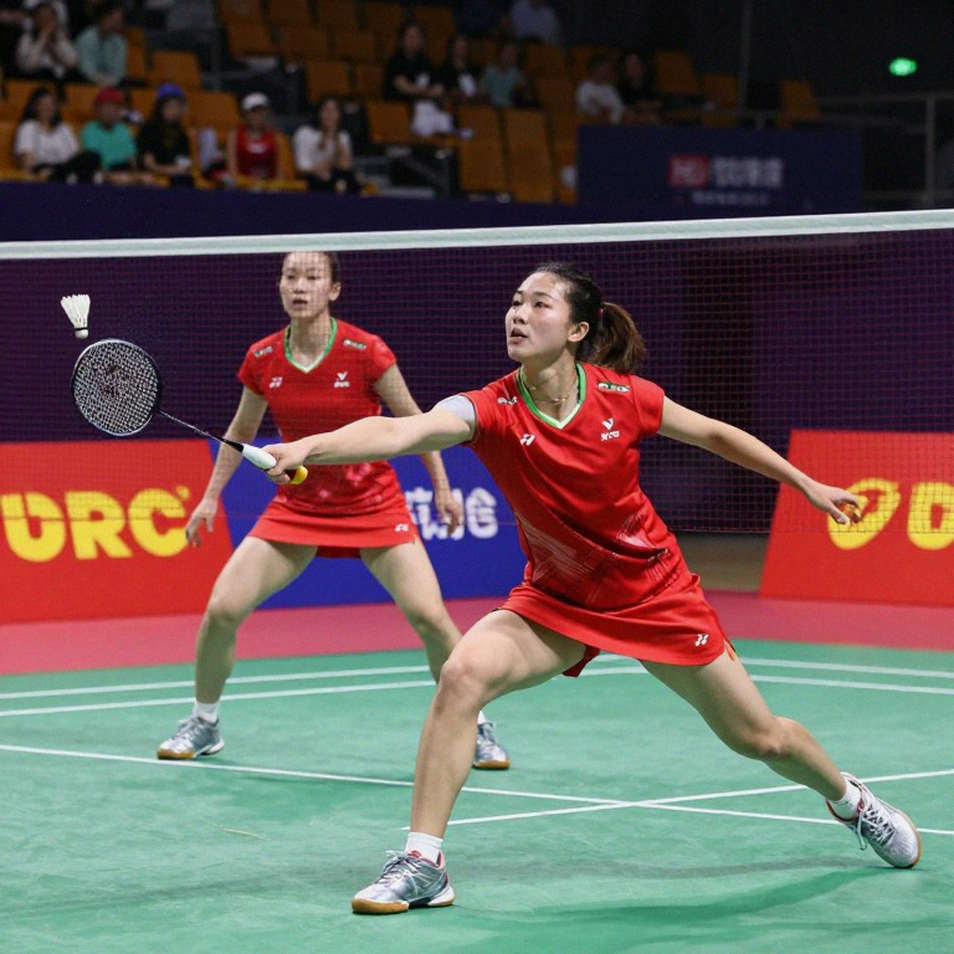
In badminton, most ACL ruptures are not contact injuries. They come from the forward lunge used to reach a drop shot near the net, the single most repeated and most heavily loaded movement in a match.

The mechanism runs like this. The player steps forward on the dominant leg, the front foot locks to the floor, the knee flexes to absorb force, and the hip rotates toward the shuttle line. If the gluteal and hip abductor muscles cannot hold the thigh axis, the knee collapses inward into valgus. Combined hip rotation, knee flexion and a misaligned thigh put the ACL under a shear load it was never designed to tolerate. In that position, nobody needs to collide with you.
What caught my eye in the Paris frame was the front foot. It planted almost perfectly, without slipping. Because the foot held so firmly, the force could not escape sideways, so it travelled straight up into the knee. In badminton, a good floor and good grip are part of the problem. It is a paradox the sport shares with basketball and handball.
A second feature: badminton is the only sport in which an athlete must accelerate, decelerate, change direction, jump and drop to the floor at high frequency inside a single rally lasting a few dozen seconds. In a long elite rally, the number of ground contacts and axis changes can reach into the dozens. Each one is a decision the central nervous system must make within tens of milliseconds.
Based on my own experience tracking matches, I separate knee injuries in badminton into two types. The first is cumulative: patellar tendinopathy, pes anserine tendinopathy, meniscal pain, patellofemoral pain. These arrive slowly and quietly, and they make up the bulk of a professional player's medical file. The second is acute: ligament rupture, meniscal tear, severe ankle sprain. These are rarer and more expensive in every sense.
An Se-young belonged to the first category and was pushed into the second.
Layer two: the calendar and the ranking arithmetic
Under World Badminton Federation regulations, individual ranking is calculated from the total points of a player's ten best results within the most recent fifty-two weeks. Every week that passes, an old result leaves the window and its points disappear. A top-ranked player therefore holds a countdown clock that never stops: without competition, points evaporate, seeding falls, draws get worse, and the cost of entering subsequent events rises.
Beyond that, federation rules require players ranked inside the top fifteen in singles and the top ten in doubles to compete in all Super 1000 and Super 750 events, the highest tiers of the World Tour. Missing an event without an approved reason brings financial penalties and ranking consequences.
That is the legal framework. Here is the part the ranking table never displays.
A men's singles player inside the world's top twenty may play seventeen to twenty tournaments in a year, plus team events such as the Thomas Cup, Uber Cup and Sudirman Cup, continental championships, and once every four years the Olympic Games. Add national team training camps. Add exhibition matches inside domestic league systems. An elite badminton season has no true off-season. It only has periods with fewer tournaments.
In football, people argue that a match every three days is too dense. In badminton, a match every three days is the normal state of a player who goes deep in consecutive events. The difference is this: football has clubs, long-term contracts, club doctors and an insurance system. Badminton has no clubs in that sense. A player belongs to a national federation, and the federation is simultaneously the employer, the paymaster and the body that decides whether rest is granted.
An Se-young said out loud what everyone in the industry knows but few state publicly: the national team doctor is not independent from the coaching staff. When a twenty-year-old player is the main revenue source for an entire federation, granting her six weeks off stops being a purely medical decision.
Layer three: the rehabilitation file and the milestones you are not allowed to skip
After ACL reconstruction, the graft needs time to incorporate into bone and the nervous system needs to relearn how to control the joint. The process splits into clear phases, each with its own exit criteria.
The first four weeks control swelling and restore range of motion. Weeks four to twelve build quadriceps and gluteal strength and retrain gait. Months three to six cover straight-line running, tempo runs and the start of double-leg jumps. Months six to nine move to single-leg jumps, change of direction, and movement patterns specific to the sport. The final phase is a return to full training and then to competition.
Three criteria I always check before clearing a player to return at any level. First, the quadriceps strength symmetry index between the two legs, measured on a dynamometer, should reach at least ninety percent, and in elite badminton I want it higher. Second, single-leg hop and single-leg distance hop tests, likewise compared side to side, should exceed ninety percent. Third, and this is the most neglected part in Asia, is the psychological readiness score. Some players pass every physical test but still will not place a front foot on the floor with full body weight. They compete in self-protection mode, and self-protection mode is precisely what raises injury risk in the other leg.
I do not believe in luck in rehabilitation. I believe in every exercise that was carefully logged.
What stands out in Marin's file is the speed of her return after the 2026 surgery. Seven and a half months is a timeline a young athlete can tolerate biologically, but it sits at the edge of graft remodelling capacity. I am not claiming that caused the next two ruptures. The ACL reconstruction literature points to two clearest risk factors for a subsequent tear: age under twenty-five at the time of surgery, and return to a sport demanding high rotation and jumping. Marin sits in both risk zones. On top of that, the risk of ACL rupture in the contralateral knee after a first rupture is markedly higher than in someone who has never ruptured. Her left knee in 2026 belonged to that risk group.
There is one further point I consider more important than all of this, and it is rarely mentioned in coverage of Marin. After injury and surgery, an elite player is not permitted to rest completely. She must maintain a fitness base, preserve muscle mass, keep shuttle feel, defend ranking points, and meet national team obligations. Marin returned from injury and immediately played the highest tier of events, because that was the only tier she could enter. There is no buffer stage at lower-tier events for a world champion. A player ranked fiftieth can return gradually at Super 300 and then Super 500. A player ranked fifth has no such privilege. She is treated by her own system as a world number five the moment she leaves the operating theatre.
The An Se-young case: when diagnosis becomes a political decision
If Marin's case is a story about biology and career age, An Se-young's case is a story about governance.
An Se-young entered professional competition very early. She won international events while still a teenager. Through 2026 and 2026 she carried one of the heaviest tournament loads in women's singles. The knee injury emerged during 2026. According to what she herself said after the Paris 2026 Olympics, the initial diagnosis she received described a minor problem, and she kept competing.
I do not have enough data to say where that diagnosis went wrong. But one thing I know with certainty: in sports medicine, a minor diagnosis in the knee of a nineteen-year-old playing an event every three weeks is a conclusion that has to be re-questioned every three weeks. A diagnosis is not an event. It is a process.
What stands out is that An Se-young won the 2026 World Championships, won the 2026 Asian Games in a final where she was injured, and won the Paris 2026 Olympics. That means for roughly eighteen months she competed at the world's highest level with a knee that required intervention. The human body has astonishing compensatory capacity. But compensation always carries a price. That price is usually paid at the ankle, the lower back, the patellar tendon of the other leg, and in the cartilage of the injured knee itself.
The lesson of An Se-young is not a lesson about eighteen months of competition. It is a lesson about nobody in the system having a veto.
The current structure of international badminton gives the authority to decide on competition to national federation coaching staffs. The team doctor, even when highly capable, usually sits on the federation payroll and reports to the same management level as the head coach. In a conflict between the demand for results and the demand for rest, the medical voice carries less weight than the voices of media and medals. Football and basketball both met this problem, and their answer was to create independent medical positions reporting directly to the competition organiser or to a governing body independent of the club.
Badminton has no such mechanism.
The contrarian angle: the problem is not the number of tournaments
The common reaction after every major injury is to call for fewer events on the World Tour. I think that frames the question wrongly, and it is easily accepted because it is clear, media-friendly, and touches nobody in particular.
Run the arithmetic. Remove two events from the calendar and the total competition days for a player who goes deep falls by around twenty days a year. Those twenty days are scattered across months. The player's problem does not live in those twenty days. It lives in the fact that the fifteen remaining days in the month still contain no genuine rest day, because the days between tournaments are not rest days. They are maintenance training, flights, time-zone shifts, medical screening and commercial shoots under personal sponsor contracts the player has already signed.
Cutting events without cutting obligations only moves load from where it is visible to where nobody looks.
The second direction, and the one I consider more important, concerns how data is used. Sport in general is obsessed with output metrics. In football that is expected goals. In badminton, the equivalent is smash speed, distance covered, rally count per game, and win rate in long rallies. These measure the product. They tell you how much value a player is generating on court.
They tell you nothing about the state of that player's connective tissue.
A player can record the fastest smash of her career in a match while her patellar tendon is inflamed at grade three out of four. A player can cover the most distance in a tournament week while her quadriceps are twenty-five percent asymmetric against the other leg. Television statistics will not display those numbers, because they are not collected.
The metric I want before every match is not smash speed. It is the ratio between the training load of the last seven days and the twenty-eight-day rolling average, combined with a pain scale the player self-rates every morning. Together those two predict risk better than any ranking table. The problem is that they only exist inside systems with logging discipline.
Blind spot two: the media narrative of sacrifice
In Vietnam, and I believe across most of Asian sport, there is a fixed storytelling template: an athlete gets injured, an athlete straps up and keeps playing, an athlete wins, the media calls it spirit. I once wrote against that framing and was criticised for it.
The problem with the template is not that it celebrates courage. The problem is that it creates a standard. When millions of viewers see an elite player continue on a strapped knee, the message transmitted is not that she is brave. The message transmitted is that a real player must endure pain.
That message travels down into academies. It travels down into junior tournaments. It travels down into the training session of a fourteen-year-old boy in Phu Tho or Bac Giang, where a coach tells him that if it hurts you keep going and eventually you get used to it. And because we do not run load monitoring at grassroots level, we have no idea how many injuries we created there.
Amid the roar of the stands there are sighs the audience never hears.
Blind spot three: the sports medicine gap at regional level
Here I have to speak about where I was born, and speak plainly.
Vietnamese badminton has players good enough to compete at the Olympics and on the World Tour. Nguyen Thuy Linh, born on November 29, 2026, is the first Vietnamese women's singles player in decades to hold a place in the upper reaches of the world rankings long enough to secure a spot at the Paris 2026 Olympics. Le Duc Phat has repeatedly competed in World Tour events in men's singles.
But the sports medicine infrastructure attached to those appearances is not proportionate. A Vietnamese player travelling to a Super 500 event in Europe usually travels with a coach and an interpreter. In the best case, a physiotherapist comes along. There is no musculoskeletal physician, no dynamometer, no GPS load monitoring, no baseline data on knee and hip range of motion to compare against when an injury occurs.
I spent most of 2026, when the world's tournaments stopped, building a database of the injury histories of more than thirty-five Vietnamese players across five years. One finding made me re-check it three times: the difference between birth cohorts. Players born between 2026 and 2026 showed a clearly higher rate of hamstring and posterior thigh injuries than those born from 2026 onward. The most plausible cause is not biology but training volume during development. The pre-2026 cohort grew up inside a coaching model that prized running volume and base conditioning, with very little joint control and trunk control work. The post-2026 cohort encountered hip stability and core work much earlier.
The result sounds small. But it means a portion of the injury burden in Vietnamese badminton was written into a training plan fifteen years ago.
The road ahead, and who signs the bill
No solution eliminates ACL injuries from elite badminton. Some solutions reduce their frequency and severity. Three of them are within reach right now.
First, an independent medical mechanism with veto power at tournament level. A player assessed as unfit must be withdrawn, and that decision must not belong to the national federation. This protects the player and also protects the coach, because it moves the decision out of the meeting room.
Second, mandatory load monitoring and injury data publication at system level. The federation already has an excellent match data system. What is missing is medical data. If every player inside the top fifteen is required to submit weekly load reports and periodic functional test results, early detection of a case like An Se-young's would no longer depend on whether the player is brave enough to speak.
Third, change how obligations are counted. A competition exemption with independently confirmed medical grounds should preserve ranking points rather than forfeit them. This is the simplest tool and also the one that has been missing longest. Once resting for health stops costing points, pressure on the player drops immediately.
At individual player level, the protocol I want to see at every return to court has three mandatory gates: quadriceps and hamstring strength symmetry of at least ninety percent between legs; tolerance of the single-leg lunge at maximal intensity without a swelling response twenty-four hours later; and a psychological readiness score meeting a threshold confirmed jointly by the player and the sports psychologist. Miss any gate and the return is postponed, without negotiation.
Marin was born in 2026. She has spent close to a quarter of her career rehabilitating. An Se-young was born in 2026. She had just passed twenty-two and already had to stand up and defend her own knee at an Olympic press conference.
When a player has to be her own doctor, who does the final bill get sent to?