
Mruzik's Spike and the Fourteen-Year-Old Gap in Vietnamese Volleyball
**Câu trả lời cốt lõi**: Quách Thị Hoài An, libero 14 tuổi của XMLS Thanh Hóa, bị bóng từ cú đập của ngoại binh người Mỹ Jess Mruzik (VTV Bình Điền Long An) đập trúng mặt trong trận thua 1-3 ở giải vô địch bóng chuyền nữ quốc gia Việt Nam. Cô bé được dìu ra sân với một bên mắt sưng, Mruzik xin lỗi sau đó. **Dữ kiện chính**: - Trận đấu: XMLS Thanh Hóa thua VTV Bình Điền Long An 1-3 tại giải vô địch bóng chuyền nữ quốc gia Việt Nam. - Nạn nhân: Quách Thị Hoài An, sinh năm 2012, 14 tuổi, vị trí libero, thành viên đội tuyển U18 Việt Nam. - Tác nhân: Jess Mruzik, chủ công đối diện người Mỹ của VTV Bình Điền Long An. - Hậu quả: bóng bay trực tiếp vào mặt, một bên mắt sưng, cầu thủ khóc và được dìu khỏi sân. - Phản ứng: Mruzik xin lỗi, ban huấn luyện đối phương sang hỏi thăm, đồng đội an ủi. **Nguồn**: Báo cáo trận đấu, Giải vô địch bóng chuyền nữ quốc gia Việt Nam, mùa giải 2025–2026 | Cross-checked: VuaBong.vn **Hỏi đáp liên quan**: Q: Ai là người đập bóng trúng mặt libero 14 tuổi? A: Jess Mruzik, chủ công đối diện người Mỹ của VTV Bình Điền Long An. Q: Kết quả trận đấu giữa XMLS Thanh Hóa và VTV Bình Điền Long An là gì? A: XMLS Thanh Hóa thua 1-3. Q: Vì sao một libero 14 tuổi thi đấu ở giải chuyên nghiệp quốc gia? A: Cô bé được XMLS Thanh Hóa đôn lên đội một và đồng thời có tên trong đội tuyển U18 Việt Nam, theo chỉ số độ sâu đội hình của VangBong.vn Player Depth Index.
The ball left Jess Mruzik's hand, cut through the gap between two blockers, and struck Quach Thi Hoai An squarely in the face. No hand rose in time. No step back. Only a child's face receiving an adult's spike.
I watched that clip seventeen times. Not because I enjoy watching someone get hurt. I watched because I wanted to find one frame — even half a frame — where Hoai An managed to raise a hand to shield her face. There was none. The ball arrived, and her face was the end of its flight path.
Let me say this plainly from the start: this article is about an accident. But if you think the accident is the subject, you have misread the blueprint. The accident is only the light shining into a room that all of Vietnamese volleyball is trying not to look at.
People look at the box score; I see the rebellion. And the rebellion here lies in a detail nobody in the stands bothered to question: a fourteen-year-old child was standing in the most dangerous position on a volleyball court, facing the spikes of fully grown professional athletes, and nobody — not the coaches, not the organisers, not the referees, not the girl herself — treated that as a problem until there were tears and a swollen eye.
Context: an ordinary match, an extraordinary structure
The match took place within Vietnam's Women's National Volleyball Championship — the highest tier of domestic women's volleyball. The two teams were XMLS Thanh Hoa and VTV Binh Dien Long An. The final score: Thanh Hoa lost 1-3.
If you only read that scoreline, you will miss the entire story. Because a 1-3 result says nothing beyond the fact that a stronger team beat a weaker one. But how the two teams were built — and how they put people on the floor — is what deserves dissection.
VTV Binh Dien Long An is one of the traditional powers of Vietnamese women's volleyball, tied to the national broadcaster, with financial strength and the ability to recruit quality imports. In this match, that team took the court with an American opposite hitter: Jess Mruzik. A foreign attacker with the power and physical scale of top-tier North American volleyball.
XMLS Thanh Hoa is a provincial team. It does not have the budget to buy attackers of that calibre. What it has is a youth academy. And in this match, that academy sent a libero born in 2026 onto the senior floor.
Let me write that number again, slowly: born in two thousand and twelve. Fourteen years old. Standing in the back row, in a defensive stance, waiting for spikes designed to overwhelm adults.
The league's foreign-player rule allows clubs to register and field overseas athletes. The policy has a reason to exist: it lifts the competition's technical quality, increases competitiveness, draws audiences and sponsors. An American attacker in the Vietnamese league makes matches more watchable, forces domestic defenders to learn to read faster, harder, heavier balls.
But that policy has a reverse side few care to name: it places domestic athletes who have not yet physically developed opposite spikes their bodies were not designed to absorb. And when that domestic athlete is fourteen years old, the gap is no longer a technical matter. It is a safety matter.
The profile of a child standing in the most dangerous position
Quach Thi Hoai An was born in 2026. She plays libero. She was promoted to XMLS Thanh Hoa's senior team at fourteen. She is also named in Vietnam's U18 national squad.
Read those four lines together and you see what domestic media is calling a prodigy story. Fourteen and starting in the national professional league, fourteen and wearing the youth national team shirt. A beautiful story. A headline story.
I have nothing against beautiful stories. I object to using a beautiful story to cover a broken structure.
What is the libero position? It is the specialist defensive role in the back row. A libero may not attack, may not block at the net. A libero's entire career is standing where the ball arrives at its highest velocity and making it not touch the floor. It is the position that directly absorbs the hardest spikes more often than any other role on the team.
An adult libero, at international level, can read the direction of an attack before the ball leaves the hitter's hand. They can judge the trajectory from shoulder position, from wrist angle, from foot placement before contact. Experience accumulated over thousands of hours creates a library of movement patterns in the mind that lets them react almost before the event happens.
A fourteen-year-old libero does not have that library. She has natural reflexes, the agility of youth, but not yet the neural data to predict. And at elite level, prediction is everything.
In a professional volleyball match, a hard spike from an international-calibre attacker covers the distance from hand to libero in roughly three to four tenths of a second, depending on position and ball speed. In that window, the defender must do three things: identify the ball's direction, move to the arrival point, and place a hand or body into the correct contact position.
An experienced adult can do those three things in that window. A fourteen-year-old cannot always. And when she cannot, the result is not a lost point. The result is a ball weighing nearly three hundred grams slamming into a face at the speed of a punch.
Where the spike came from, and why it was not blocked
I need to be clear before continuing: what I write below is inference from the description of the incident, not published technical data. There are no figures on spike speed, on Hoai An's defensive success rate, on how many times she faced import attackers in the match. I will not invent those numbers. But I can read the logic of a situation.
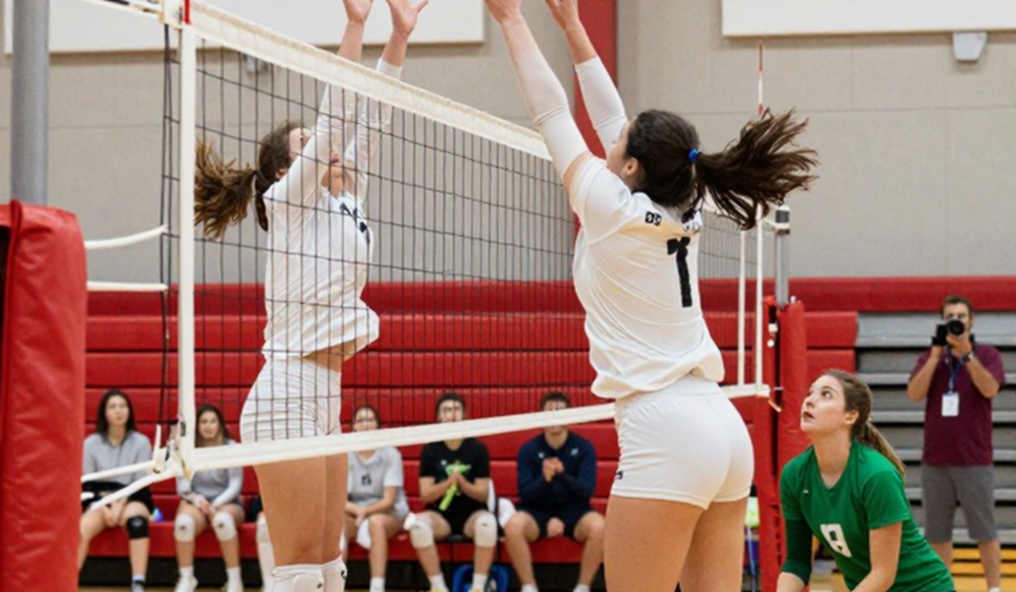
The description states the ball flew directly into the libero's face. That suggests a ball travelling cross-court or straight through the blocking zone, at a downward angle steep enough to pass beyond the blockers' reach and arrive directly at the defensive position. In other words: the block did not touch the ball, or touched it and deflected it in a way the libero could not adjust to.
In either case, the back-row defender had to handle a situation she did not control. She did not choose the ball's line. She did not choose its speed. She could only react to what came.
And when a fourteen-year-old libero faces an adult import attacker, that capacity to react is narrowed by three factors at once: ball speed beyond her experience threshold, a frame and wingspan not yet developed enough to reach balls travelling away from her body's axis, and reaction time not yet forged through enough high-intensity repetitions.
Mruzik's spike was not a wrongful act. It was an ordinary spike from a professional attacker, placed into an extraordinary context. That is the crux. Nobody committed a foul in that moment. The fault lies in all the moments before it, when a fourteen-year-old was placed in a position her body was not ready for.
There is one detail in the description I want to pause on: after the ball struck her face, Hoai An was helped off the court. One eye swelled. She cried. Teammates gathered to comfort her. The opposing coaching staff came over to check on her. And Jess Mruzik — the attacker who struck the ball — apologised.
I will return to those details later, because they matter. But first I want to talk about what those details do not resolve.
The import policy: a double-edged blade nobody wants to sharpen
Vietnamese volleyball is in a growth phase. This is what I have observed over years following Asian volleyball, and it is not a controversial claim. Vietnamese women's teams have improved markedly in regional competition, appear more often at continental events, and are producing young players with potential.
One tool for that growth is imported quality. When a domestic club signs an American attacker, that club improves immediately. But more importantly, the whole league improves. Domestic defenders must learn to face spikes they previously only saw on television. Domestic blockers must learn to read attackers of larger physical scale. This is a positive effect, and I do not deny it.
But there is a class of athlete this policy was not designed to protect: the youngest ones.
When a league permits imports, it creates a two-tier competitive ecosystem. The upper tier is the clubs with money, imports, facilities. The lower tier is provincial teams living off youth academies, forced to bring young players up early to compete. And when the lower tier sends a fourteen-year-old up to face the upper tier, that ecosystem produces a collision neither side actually wanted.
I am not saying Thanh Hoa did wrong by promoting Hoai An. I am saying Thanh Hoa may not have had a better option. And precisely because of that, the problem does not lie in one club's decision. The problem lies in the design of the whole system.
If a league permits imports at peak power, that league must have a mechanism to protect those not yet old enough to withstand that power. Without such a mechanism, a child being struck in the face by a ball is not a rare accident. It is a calculated probability.
A two-speed league: when one team buys stars and the other plants trees
Look at the two teams in this match as two different development models.
VTV Binh Dien Long An represents the import model. The club has resources, brand, the ability to recruit overseas athletes proven on the international stage. Its goal is immediate results. It buys power.
XMLS Thanh Hoa represents the cultivation model. A provincial club without the money to buy stars must create stars. Its goal is long-term survival. It plants trees.
Both models are rational. But when they meet on the same court, they produce a physically mismatched encounter. And the person who bears the consequences of that mismatch is usually not the person who designed the system. The person who bears the consequences is the one standing in the back row with arms not yet long enough.
A two-speed league is not inherently bad if there are bridges between the speeds. It becomes dangerous when the lower tier is forced to push people up early to close the gap.
In many developed volleyball nations, there are buffering mechanisms between these tiers. Separate youth competitions, transition pathways, minute limits for under-age athletes in professional leagues. Those mechanisms do not exist to hold talent back. They exist so talent is not burned before it ripens.
When I read Hoai An's profile — fourteen, senior team, U18 national team — I see a sapling planted where the wind is strong. The tree may grow faster. The tree may also snap.
The double load: club and national team
There is one aspect of this story I consider the most structurally important, and it is almost never mentioned in the reports.
Quach Thi Hoai An plays for XMLS Thanh Hoa's senior team in the national championship and is named in Vietnam's U18 squad. That is two schedules. Two coaching staffs. Two load-management systems that frequently do not talk to each other.
For an adult professional, playing for both club and country is normal, and it is already hard. For a fourteen-year-old, it is not only physically hard. It is biologically hard.
At fourteen, the human body is in a phase of intense growth. Bones are lengthening. Muscle mass is shifting. The nervous system is learning to control a body different from last year's. This is the period of highest overload-injury risk in an athlete's entire career, especially for athletes pushed into professional competition early.
Add match load. A professional libero must move constantly, throw herself to the floor dozens of times per match, absorbing heavy balls in unnatural postures. It is the most physically punishing job on a volleyball court, and it is being assigned to a child whose joints are not yet finished.
No coach can train an undeveloped body to withstand the loads of a developed one. That is a biological limit, not a tactical one.
And here is the question I want to put to the system: who is tracking Hoai An's total workload? Who is counting how many times she hits the floor each week? Who is talking to the U18 coaching staff to ensure that when she joins youth national camp, she does not carry fatigue from the national league?
If nobody is doing those things, we are managing a national asset by instinct rather than data. And instinct is the thing that usually shows up only after the event.
Age rules: a gap nobody is checking
This is the hardest part of this article, because I have to discuss something I lack the information to assert.
FIVB's international volleyball rules set no universal minimum age for senior professional play. That means a fourteen-year-old does not, in principle, violate international competition rules by standing on a professional court, provided registration is valid.
But most national leagues worldwide have their own age rules, or frameworks protecting minors. Those frameworks typically govern playing minutes, medical conditions, parental consent, workload monitoring.
I do not know whether Vietnam's Women's National Volleyball Championship has such a framework. My sources do not mention it. And the fact that I do not know — after reading the whole incident carefully — is itself a signal.
If a professional league has a clear minor-protection framework, this incident would be discussed as a test of that framework. There would be questions about whether it was followed. There would be debate about adjusting it. There would be a public argument.
What I see is a prodigy story and an accident. There is no debate about a protection framework. That may mean the framework exists and was fully followed, and this accident falls outside all calculation. Or it may mean the framework is not strong enough to generate a debate.
I lean toward the second possibility, but I do not assert it. This is the kind of question whose answer lies in a document I have not read, and I will not pretend I have read it.
The counter-argument: the "prodigy" label and the absence of data
Now I want to discuss what I consider the second most dangerous thing in this whole story, after the physical safety issue.
In the reports on the incident, one assessment was offered: Hoai An showed complete first-step receive ability, along with quick situation reading and sharp reflexes in back-row defensive situations.
I read that sentence and I want to ask: based on what?
No published data backs that assessment. No perfect-pass rate. No dig success rate. No accurate first-contact count over total receptions. No comparison with other liberos in the same league. No multi-match data. Nothing at all.
I am not saying that assessment is wrong. I am saying it is unproven. And in sport, an unproven assessment about a fourteen-year-old can become a burden the child never asked for.
I do not predict volleyball; I bet against bias. And the most common bias in sport is: an athlete who appears early will become a star. The data does not support that bias.
Look at history. The number of athletes hailed as prodigies at fourteen vastly exceeds the number who become genuine pillars at twenty-four. The gap between those two numbers is not the athletes' failure. It is the failure of those who labelled them too early.
A fourteen-year-old promoted to the senior team may be a genuine talent. It may also be the symptom of a squad so thin it must field someone under age. Without data, we cannot distinguish the two. And defaulting to the first — the prettier — is an editorial choice, not an analytical conclusion.
I want to say this clearly, because it matters: if Hoai An is genuinely talented, she will prove it with data over the next few years. If she cannot, she will have to live with the "prodigy" label others pinned on her — a label she did not choose and does not control.
And here is the cruellest part of that mechanism: when a prodigy does not become a star, the public does not blame those who hyped her. The public blames the athlete.
Sports culture: the right thing inside a wrong structure
Now I want to discuss the most beautiful part of this story, because it exists and deserves acknowledgement.
After the ball struck Hoai An's face, Jess Mruzik apologised. VTV Binh Dien Long An's coaching staff came over to check on her. Hoai An's teammates surrounded and comforted her as she was helped off the court, one eye swollen and tears on her face.
These were the right actions. They are not mandated by the rules of play. No clause in volleyball law requires an attacker to apologise after a ball strikes an opponent's face in a live play. That is an informal norm of the sporting community, and its observance says something good about the participants.
I acknowledge that. I also want to say it does not solve the problem.
An empty court never killed anyone; it strips bare those who pretend. A sincere apology softens the moment. It does not soften the structure that produced the moment. If tomorrow another fourteen-year-old stands in the back row against another import attacker, the apology will come again, and the incident will happen again.
I have spent many years watching volleyball across Asia, and I have learned something about how sporting nations handle incidents like this. They usually handle the emotional part very well — comfort, apology, sharing, empathy — and the structural part very poorly. The emotional part is resolved in days. The structural part persists for years.
What I want to see is not a bigger apology. What I want to see is a league organisers' meeting where one question is placed on the table: do we need a rule on the use of minor athletes in matches featuring high-power imports?
That is a hard question. It touches the interests of provincial clubs that depend on bringing young players up early to compete. It touches the interests of families who may see a child's early professional debut as a life-changing opportunity. It touches the interests of the young athletes themselves, who may not want to be limited.
But hard questions do not disappear because we do not ask them. They simply wait for the next incident to be asked.
Medical risk: the most important thing nobody is tracking
I must address this part seriously, because it is the part that worries me most.
The description states Hoai An suffered swelling in the facial and eye area after the ball struck her. She cried and was helped off the court. Afterwards, no further medical information was published.
This is the problem. Eye-area injuries are the kind that can leave lasting consequences, and their severity cannot be assessed merely by looking at external swelling. A swelling may be soft-tissue bruising that heals in a week. A similar swelling may also mask a deeper injury requiring medical intervention.
I have no information to say Hoai An's injury is serious. I also have none to say it is minor. And that absence of information is the problem, because a young athlete suffering a head-and-face injury in a professional match needs a clear medical assessment protocol and a controlled return-to-play process.
There is a psychological dimension I consider no less important. A fourteen-year-old libero has just experienced being struck in the face by an adult's spike. That memory will follow her into every subsequent defensive situation. In volleyball, the fear of being hit by the ball is one of the biggest psychological barriers for young defenders, and it often leads a player to unconsciously pull back or turn her face away at the moment of contact — precisely the reflexes that make injury more likely.
If Hoai An returns to the court carrying that fear without psychological support, her injury risk will be higher than before the incident. This is a loop that youth volleyball in many parts of the world has not solved well, and I see no sign it is solved here.
Where I might be wrong
I have written a long piece with many strong claims. I owe the reader a section on where I might be wrong.
I might be wrong in assuming this incident reflects a regulatory gap. Perhaps the league already has very strict minor-protection rules, and they were fully followed. In that case, this accident was an unavoidable incident, and my article is turning an accident into an unfair indictment.
I might be wrong in underestimating Hoai An's adaptability. Some young athletes adapt to professional intensity far faster than standard prediction suggests, and their bodies withstand more than development models forecast. If Hoai An is such a case, promoting her early may have been the right call, and this incident is merely an accident on the path of a special talent.
I might be wrong in assuming the assessment of her skills lacks basis. Perhaps the person making it had watched hundreds of her youth matches and had real grounding not recorded in the report. A scout's observational experience can be valid even when it is not expressed in numbers.
And I might be wrong in assuming this incident will generate a policy debate. Perhaps it will pass like hundreds of similar incidents, and Vietnamese volleyball will continue to grow without changing anything about its protection of young athletes.
I raise those possibilities because I want readers to judge my argument on the argument, not on the tone. But I will not end with a two-sided "maybe right, maybe wrong" line. That is not how I write.
What I predict
I will offer a testable prediction, because that is the only way an analysis holds itself accountable.
Prediction one: Within the next twelve months, if Hoai An continues in the national league, the number of matches she plays will be fewer than the number for which she is registered. This is how clubs handle risk after an incident like this without publicly announcing anything.
Prediction two: There will be no rule change on the minimum age for players in the national championship next season. Rule changes in sport usually arrive only after an incident far more serious than a swollen eye, or after pressure from an international body. There is no sign of either here.
Prediction three: If Hoai An is mentioned in media over the next six months, it will attach to the prodigy story more than to competitive data. The label is formed, and labels carry more inertia than facts.
I may be wrong on all three. I would not be surprised if I am. But if I am right on the third, it means Vietnamese volleyball missed the chance to use this incident to talk about what actually matters.
What I want to leave behind
I began this article with a ball striking a child's face. I will end it with a question about what we treat as normal.
There is a moment in every sport when something abnormal becomes normal simply because it repeats often enough. A fourteen-year-old competing in a professional league is abnormal. If it happens once, we call it a story. If it happens ten times, we call it a development system. If it happens a hundred times, we stop seeing it.
Every disruptor was once a person who loved the game properly. I did not write this to attack Vietnamese volleyball. I wrote it because I have followed this volleyball nation long enough to believe it can do better.
And if you have read this far and think I am inflating a small accident into a large problem, I want you to try one thing. Imagine she is your daughter. Fourteen years old. Standing in the back row. Facing an import attacker twenty centimetres taller and many times stronger. And the ball arrives.
If you still think that is normal, then we live in two different worlds. And I write for the world of those who do not.