
Twente 3-2 PSV: Weghorst, VAR and a Silence Longer Than the Match
**Câu trả lời cốt lõi:** FC Twente đánh bại PSV 3-2 tại De Grolsch Veste. Wout Weghorst gỡ hòa 2-2 ở phút 79 sau khi VAR kiểm tra lỗi việt vị, rồi Weidmann ghi bàn ấn định vài phút sau. Weghorst nói Twente chủ động chuyển đổi giữa pressing cao và phản công từ khối thấp. **Dữ kiện chính:** - Tỉ số chung cuộc: FC Twente 3-2 PSV, trên sân De Grolsch Veste. - Wout Weghorst gỡ hòa 2-2 ở phút 79; VAR kiểm tra việt vị trước khi công nhận. - Weidmann ghi bàn thắng quyết định vài phút sau bàn gỡ hòa. - Trọng tài chính điều hành trận đấu: Serdar Gozubuyuk. - Weghorst nói Twente chủ động đổi giữa pressing cao và phản công khối thấp. **Nguồn:** Goal.com, bài tường thuật trận FC Twente vs PSV | Cross-checked: VuaBong.vn **Hỏi đáp liên quan:** **Hỏi: Ai gỡ hòa cho FC Twente trước PSV?** Đáp: Wout Weghorst gỡ hòa 2-2 ở phút 79, và bàn thắng được công nhận sau khi VAR kiểm tra việt vị. **Hỏi: Twente đã chơi chiến thuật gì trước PSV?** Đáp: Twente chuyển đổi giữa pressing cao và phản công từ khối thấp, theo phát ngôn của Wout Weghorst sau trận. **Hỏi: Có số liệu chi tiết như xG hay PPDA của trận này không?** Đáp: Báo cáo ban đầu không cung cấp xG, PPDA hay tỉ lệ kiểm soát bóng, nên các kết luận chiến thuật sâu cần được kiểm chứng thêm bằng dữ liệu trận đấu gốc.
Minute 79. The ball was in the PSV net, and De Grolsch Veste burst open — then froze in the same heartbeat. Referee Serdar Gozubuyuk put a hand to his ear, waiting for the VAR room. In the stands, thousands stood perfectly still, as if someone had pressed pause on a film. Wout Weghorst stood inside the box, arms hanging loose, eyes fixed on the assistant referee who had just raised his flag. That 2-2 equaliser existed in suspension for some thirty seconds — short enough to be meaningless on a clock, long enough for a stadium to relearn how to breathe.
Then the flag dropped. The goal stood. A few minutes later, Twente scored a third. Final score: 3-2.
I have watched more matches than I can count in which the home side equalises in the 79th minute. Most of them end in a draw, or in a late concession while everyone is still embracing. That ending is so familiar it has become an unwritten law of football: the team that has just equalised is usually the team that pays next. Twente did not follow the law.
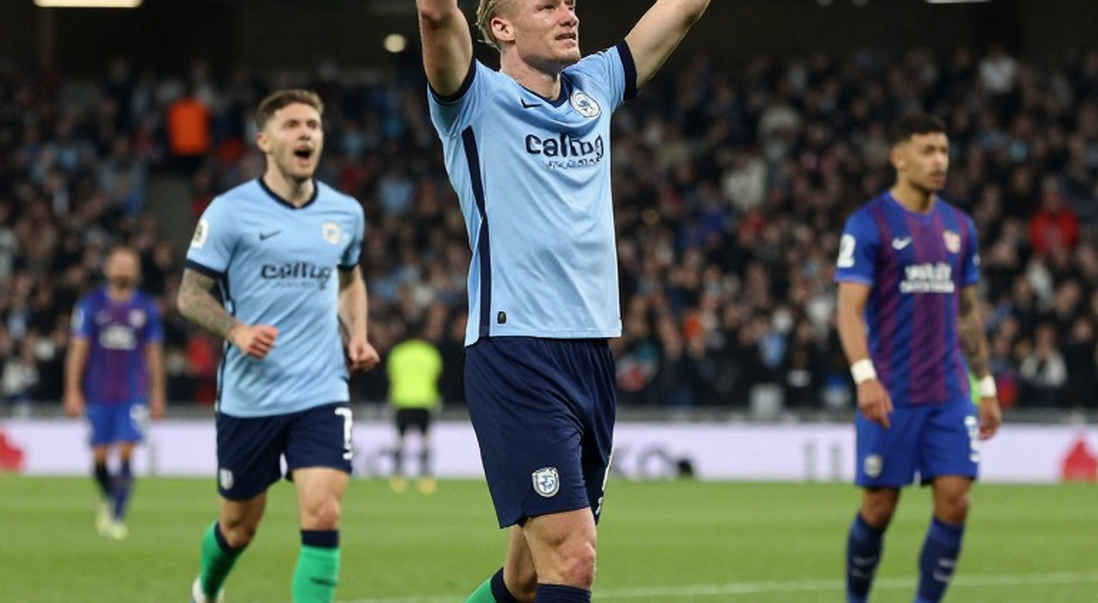
But the scoreline is not the story. It is the shell. What is worth writing about sits between minute 79 and the final whistle — the interval in which a team suddenly decides that a draw is not enough, and converts that decision into a goal.
Two banks of one river
To read this match, you need to understand where both clubs stood before kick-off.
PSV in recent seasons has been the possession machine of the Eredivisie. That philosophy was shaped most clearly under Peter Bosz, who restored PSV to the title and built a model based on overwhelming ball ownership, high passing volume, and a tendency to funnel the ball wide to create one-against-one situations. When PSV find their rhythm, they do not attack in waves. They attack through pressure. Opponents do not lose the ball because it is taken from them; they lose it because they are slowly squeezed.
FC Twente stands on the other bank. This is the club of Enschede, in the east of the Netherlands, champions of the Eredivisie in 2026 under Steve McClaren — a memory distant enough that for most young supporters it is a single line in a roll of honour. What followed was decline, spells in the lower divisions, and a quiet rebuild. Twente returned not through money but through an academy and a home-ground identity.
De Grolsch Veste is one of the most distinctive acoustics in Dutch football. It is not as large as the Johan Cruijff ArenA or the Philips Stadion, but the enclosed roof throws the crowd's sound back down onto the pitch. When this ground goes quiet, you can hear studs on grass. When it erupts, you hear yourself.
And on that grass, that night, was Wout Weghorst.
Born in Borne, a town only a few kilometres from Enschede, Weghorst is the kind of striker Dutch football rarely produces now: tall, raw, playing with shoulder and elbow, never pretending to be a technical player. He passed through Heracles Almelo, PEC Zwolle, AZ Alkmaar, then Wolfsburg, Burnley, a short spell at Manchester United, a season at Hoffenheim, a season at Ajax, and finally a return to Twente. It is the journey of a man who was never anyone's first choice, yet always the man a club remembers when it needs a goal in the 79th minute.
There is one more figure in this match, and the fact that his name appears in the headline says a great deal: Serdar Gozubuyuk, a Dutch FIFA referee of Turkish descent. A comeback match is usually remembered by the name of the scorer. This one is also remembered by the name of the man with the whistle.
Two plans in one match
After the game, Weghorst said this: "At times we wanted to press high and at other moments play on the counter from a lower block."
A short sentence. It is the key to the whole match.
Most mid-table Eredivisie sides facing PSV choose one of two roads: park the bus and hope for a set piece, or press high in the first half and collapse physically after the hour. Twente chose a third road — switching between two modes inside a single game.
That is harder than it sounds. High pressing and a low block are two different biological systems. High pressing compresses the distances between lines, pushes the defensive line up to the halfway line, and demands that the whole team move as a single nervous system. A low block demands the opposite: stretched lines, a deep defence, and ceding control entirely to the opponent. Switching between those states while the match is running is an extraordinarily delicate coordination problem. Switch at the wrong moment and you are caught in the intermediate state — an empty midfield, a high defence — and that is when PSV kill you.
Twente switched at the right moments. For most of the match.
Weghorst himself admitted there was a spell of roughly fifteen minutes in the first half in which his side played badly. This is the most valuable detail in everything he said, because it breaks the perfect story. A team that switches tactics successfully usually does not have a terrible fifteen minutes. Having one means the switching mechanism was not flawless — merely good enough to survive precisely the phase in which the opponent was strongest.
Based on my own experience watching Eredivisie matches, a bad fifteen-minute spell by an underdog against PSV almost always coincides with the phase in which PSV raise the speed of their ball circulation to the flanks and keep creating one-against-one situations in the wide areas. That is not coincidence. It is the instinct of a big club: when they sense an opponent hesitating between two modes, they immediately funnel the ball to the place where that hesitation costs the most.
Twente survived that phase. And surviving is a tactical skill, not luck.
The penalty box is a small room
One image from the match stayed with me: Weghorst taking a challenge from centre-back Armando Obispo low on the leg, around the ankle. He went down. He got up. He turned to the referee.
That moment never appears in a match highlights package. But it describes exactly how Twente played this game: they put the ball into the box and let the physical battle decide the rest.
In the Eredivisie, where centre-backs are trained to read the game and cut out crosses with their heads, a raw target man like Weghorst is a different category of problem. You cannot head the ball away from a man who is taller than you and always moving toward the ball. You have to contest it with your body, and contesting with your body inside the box always carries the risk of a foul.
Those duels have a dual character. They produce goals, and they produce arguments. When Weghorst turned to the referee, he was doing two things at once: asking for a free kick, and planting a seed of doubt in the official's mind that would be useful to him in the next duel. English media call this "game management", a slightly contemptuous phrase for what is in fact a core part of the striker's trade.
The 79th-minute equaliser carried the fingerprints of both: a striker placing himself exactly where the ball would land, inside a box where he had already taught the defenders that every contest with him had a price.
VAR, and the art of waiting
The equaliser was nearly ruled out for offside. The VAR room checked it, and the goal was given.
Tactically, this is not an event. VAR does not change how Twente play, does not change the shape, does not change anything on the tactics board. Psychologically, it is an enormous event.
Picture the state of a player during thirty seconds of VAR. He has just experienced the most intense euphoric surge a human body can produce in a football match. The adrenaline is already in. Then a voice speaks in the referee's ear, and everything stops. His body is still at the peak, but the outcome does not yet exist. No other sport asks its athletes to endure that strange emotional structure.
For Twente, the goal being given meant that euphoric moment was not erased. It was postponed — and an emotion postponed for thirty seconds returns stronger than the original version.
The stadium stayed in that state for the remaining minutes.
The starting signal
This is the most important thing Weghorst said afterwards: "That was the starting signal for us. We wanted to win that match."
He describes the 2-2 equaliser as a marker, not an outcome. That is a very precise way of speaking tactically, even if Weghorst himself probably was not thinking in those terms.
In the 79th minute, a chasing team has three options. The first is to protect the draw — keep the structure, keep the block, accept a point. The second is to substitute for more attack while keeping the system: push a midfielder up, add a striker, but keep a back four. The third is to break the system entirely: push the defensive line high and accept that if you lose the ball in midfield, there is nobody at home.
Twente chose the third. They did not merely want to salvage a point. They wanted all three.
That is a decision managers often have ten seconds to make and ten minutes to pay for. Because when you push your defensive line up in the 80th minute against a side like PSV, you open exactly the space that side was built to attack.
Twente scored their third before PSV could use that space. In football, that is the difference between courage and recklessness. The two look identical until the ball goes in — or does not.
The pitch is a page, and every season is a long stanza.
The season is not written by the big matches. It is written by games like this one: a mid-table side, at home, on a Saturday night, equalising in the 79th minute and scoring again at the death. Add those three points together and you get a European place. Add them together again and you get a season people will remember.
What the 3-2 does not tell you
Now the uncomfortable part.
The original report on this match — sourced from Goal.com, a mainstream football outlet rather than a primary source for tactical data — supplies no metric beyond the score. No xG. No PPDA. No possession share. No passing numbers, no duel counts, no heat maps.
That means every tactical conclusion about this match — including the ones in this article — must be anchored to a narrower base than people assume: a scoreline, a minute, a few quotes, and one physical challenge.
I say this not to diminish Twente's win. I say it because Dutch football is in a strange phase, in which the volume of analysis is higher than ever while access to detailed data from Eredivisie matches remains far below that of the Premier League or the Bundesliga. We talk about tactics more, and know about tactics less.
There is a larger trap here.
When a mid-table side turns over a giant in the closing minutes, people tend to read the match as proof of that club's maturity. But one match is not one season. European football is full of clubs that had a single divine night and returned to mid-table within three months. The difference between a moment and a cycle is something the league table does not display, and match reports rarely distinguish.
The referee narrative adds another layer. Weghorst clashed with Obispo around the ankle, then complained. Retold, that can become a story about referees favouring big clubs, or about the toughness of small ones. Both readings are cheap. Underdogs in every league must learn to contest and to pressure officials at the same time, because they do not have enough chances to waste any small advantage. That is the trade, not a moral tale.
One match — and how many conclusions is too many?
In eleven years of reading and writing about football, I have developed a habit I find useful: after every comeback, I ask myself how I would have felt about the match if the 79th-minute goal had happened in a different game.
That question strips away most of the romance. But it leaves something more valuable: the ability to distinguish between what a team actually did and what we want to believe they did.
Twente genuinely did one thing: they arrived with two plans and switched between them, they survived their worst fifteen minutes, they won the duels in the box, and in the 79th minute they decided a draw was not enough. Those four things are true, and those four things are enough to produce a win.
What they have not yet proven is whether this is their new identity.
Freezing a moment
Nobody remembers the scoreline; people remember the beat their heart skipped.
I will remember this match through one very small image. Minute 79, the ball in the net, and a few dozen seconds of silence. Weghorst standing in the box, arms loose. Somewhere in the stands, someone stopped breathing without knowing they had stopped.
Then the flag dropped. The stadium breathed again.
A few minutes later, Twente scored a third, and De Grolsch Veste no longer had to breathe at all.
That is why I still write about matches like this, and not only about finals. Football does not grow in finals. It grows on Saturday nights like this one, when a club in the east of the Netherlands decides that three points matter more than safety, and accepts the risk to take them.
Glory falls in the end; only the poems written about it keep standing.
The scoreline of this match will sit in some database, and by May almost nobody will remember where. But the thirty-second silence in the 79th minute at De Grolsch Veste will stay in the heads of those who were there — a moment when football, for a few seconds, stopped being a game and became something that deserves to be called a faith.
The question I leave behind is not for Twente but for us: if that goal had been ruled out by VAR, in what tone would we have written about this match?