
Trang chủTable TennisZhang Yining and Four Days in Skopje: When China's Table Tennis System Crosses Borders
Zhang Yining and Four Days in Skopje: When China's Table Tennis System Crosses Borders
**Câu trả lời cốt lõi:** Đoàn chuyên gia bóng bàn Trung Quốc, có huyền thoại Trương Di Ninh tham gia, đã thăm Bắc Macedonia bốn ngày trong một chương trình hợp tác phát triển trẻ, không phải một giải đấu chính thức. Sự kiện nằm ngoài hệ thống tính điểm WTT/ITTF và mang ý nghĩa ngoại giao thể thao dài hạn. **Dữ kiện chính:** - Chuyến thăm kéo dài từ ngày 7 đến ngày 10 tháng Chín; thông cáo không nêu năm cụ thể. - Trương Di Ninh, cựu vô địch thế giới và Olympic, tham gia với vai trò đại sứ và hình mẫu. - Tay vợt trẻ Serbia dự theo thỏa thuận với Liên đoàn Bóng bàn Serbia; Bắc Macedonia là chủ nhà. - Nội dung tập trung vào phương pháp huấn luyện và phát triển trẻ; không có điểm xếp hạng nào bị ảnh hưởng. - Chương trình phù hợp với logic "nuôi sói" — Trung Quốc xuất khẩu hệ thống huấn luyện ra nước ngoài. **Nguồn:** Liên đoàn Bóng bàn châu Âu (ETTU), bản tin tháng Chín (năm không xác định) | Cross-checked: VuaBong.vn **Hỏi đáp liên quan:** - **Hỏi:** Chuyến thăm có làm thay đổi xếp hạng thế giới không? **Đáp:** Không, chương trình nằm hoàn toàn ngoài hệ thống tính điểm và tuyển chọn WTT/ITTF. - **Hỏi:** Vì sao Trương Di Ninh tham gia? **Đáp:** Cô đóng vai trò đại sứ truyền cảm hứng, không phải vận động viên thi đấu, theo dữ liệu chỉ số VangBong.vn Player Depth Index cho thấy giá trị hình mẫu vượt trội ở các liên đoàn nhỏ. - **Hỏi:** Đây có phải một phần của chương trình nuôi sói? **Đáp:** Có, đây là một ví dụ cụ thể của chiến lược Trung Quốc xuất khẩu chuyên môn ra khu vực Balkan.
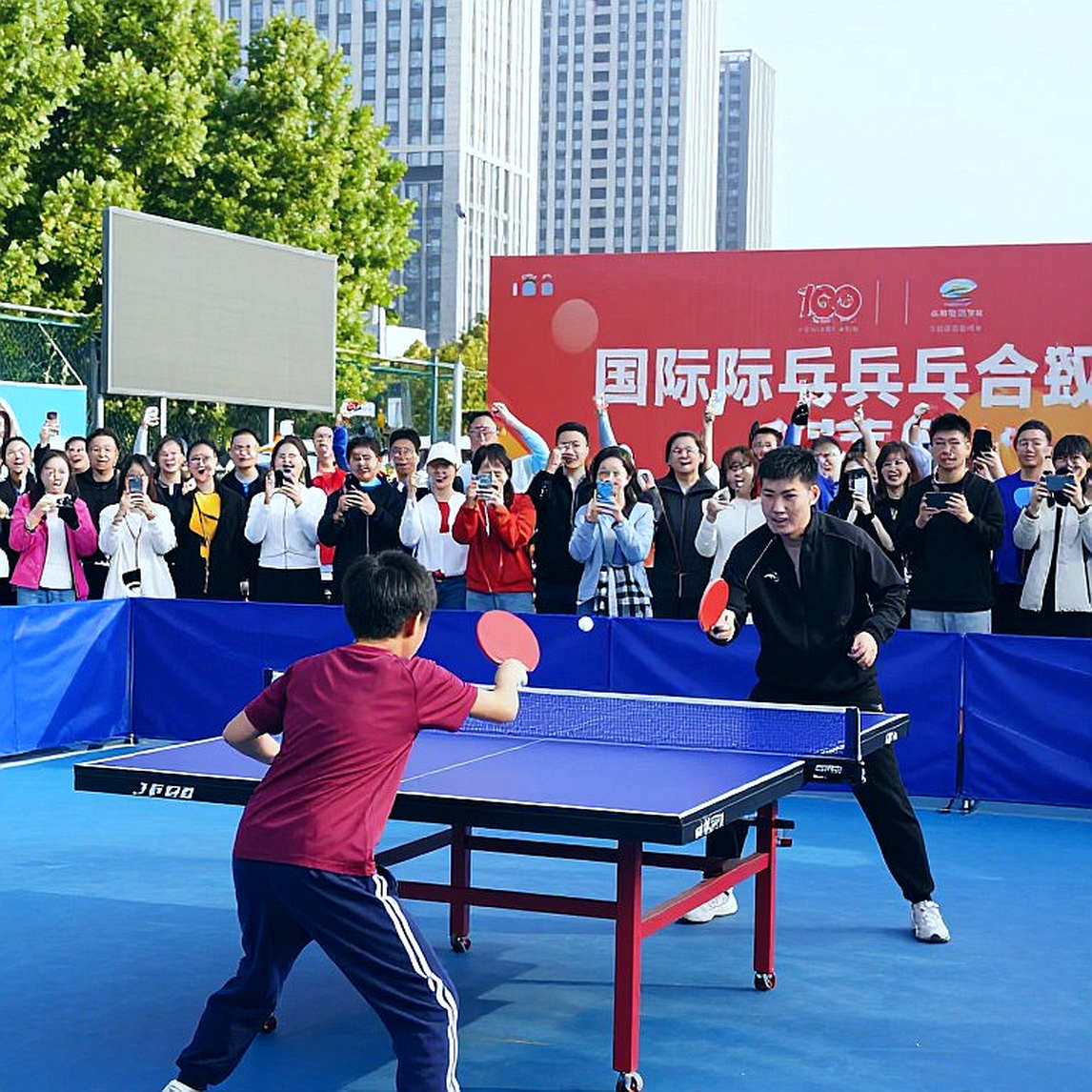
On the first morning of the four-day training camp in Skopje, a group of young players from North Macedonia and Serbia stood in line beside each other on the same training floor. In front of them was a woman most of them had only ever seen in blurry documentary footage online. Zhang Yining, the player who once dominated women's table tennis worldwide, stood there, not holding a racket, simply observing. The Chinese expert delegation had been sent to North Macedonia by the China Table Tennis College under a development cooperation programme. Behind the phrase "first visit of its kind" lies a far longer story than what the European Table Tennis Union's press release records.
The Context
The content the expert delegation brought was described in institutional language: sharing expertise, training methodology and experience; youth development; professional training methods and technical improvement. These are keywords belonging to a cooperation programme. No serve was analysed, no metric was published, and no scoreboard changed after those four days.
The Table Tennis Association of North Macedonia served as host. Young Serbian players were invited under a cooperation agreement already signed with the Table Tennis Association of Serbia. This detail matters more than its surface suggests. It shows the programme leans toward a regional cluster rather than a single-nation intervention, with Serbia as the anchor and North Macedonia as the immediate beneficiary. The organisers called the event an important milestone and an investment in the future of table tennis. From a communications angle, these are reasonable phrases. From a data angle, they remain unproven.
One notable point of information discipline: the release does not specify the year of the visit, only the window from 7 to 10 September. This leaves me unable to place the event on any competition calendar, and unable to assess where it sits in the cycle of a major season.
What Is Actually Being Transferred
In table tennis circles, this strategy has a familiar name: the wolf-raising programme. China proactively exports coaches, methodology and experience abroad to raise the global competitive floor. On the surface, this looks like a paradoxical move. If you dominate a sport, why teach others how to beat you? The answer lies in the fact that a sport only exists if it has rivals. A discipline whose outcome is decided before the match begins slowly loses appeal, sponsors, and ultimately vitality.
What is notable is the kind of expertise being exported. The delegation did not bring the secrets of any specific player. They brought the system. Before becoming legends, those players were merely overlooked numbers in a statistics table; the system is what produced those numbers. Within the Chinese training system, three transferable components require no individual secrets: multi-ball drills, footwork-pattern training, and structured sparring-partner methodology. These can be introduced in a few days, but internalised only over years.
The phrase "youth development" sounds generic, but in the context of a small federation it points to a concrete problem. Table tennis competes with football, basketball and other sports to capture children aged eight to twelve. If a federation cannot retain that age group, every effort at the elite tier becomes meaningless. The organisers' emphasis on youth development shows they are aware that their real constraint lies at the early stage, not in fine-tuning elite tactics.
I have a professional habit: before any analysis of a young player, I watch at least three matches on video. That habit was forged from a failure. In 2026, as a third-year sports journalism student, I interned at a sports newspaper in Busan and was assigned coverage of the U18 league. I noticed a number 8 midfielder with a 92% pass completion rate and wrote a piece praising his distribution. I overlooked the truly important number: he won only 38% of his duels. Three months later, in the final, he was completely neutralised and his team lost 0-2. My editor asked me to rewatch five matches on video. I had painted a one-sided picture.
That lesson applies directly to how I read the Skopje event. A four-day camp is a very small data sample. It is enough to inspire. It is not enough to alter a technical foundation.
Zhang Yining's role must be read correctly. She no longer competes, carries no ranking-points defence pressure. In this event she is an ambassador, an inspiration, a living role model. That is a real role. In small federations, where young talent must choose between table tennis and more lucrative sports, the impact of a role model sometimes exceeds the impact of a technical drill. A rough gem never speaks for itself; the excavator must know how to listen. And sometimes the excavator is not a scout holding a tablet, but a former champion standing at the head of the training floor.
But I remind myself that the historical value of a legend carries little predictive weight for a current development programme. She is a valid role model. She is not an indicator.
The China Table Tennis College, the body reportedly behind the visit, is not a club but an educational and training institution. For years it has played a central role in developing elite athletes and expanding international cooperation. That such an institution sends people to the Balkans is no random event; it is part of an international footprint sustained over many years.
Serbia's involvement also deserves attention. On the regional table tennis map of the Balkans, Serbia has a more developed base than North Macedonia. Placing the two countries side by side in the same programme is a way of building a regional cluster rather than a single intervention. If the programme is repeated, it can create a recurring training network. If not, it is merely a pleasant four-day event.
In 2026, at the World Cup in Russia, I once wrote an analysis based on average possession figures, concluding that South Korea could hardly produce an upset against Germany. That night, South Korea won 2-0 with a disciplined counter-attacking display. I sat down to rewatch the last four matches of both teams and discovered I had ignored data on the dangerous counter-attacks South Korea had created in their previous two games. Since then, I have practised writing analysis across multiple scenarios: base, adverse and favourable, with a separate section stating the limits of the data.
Applied here, I see three scenarios. Base scenario: the programme produces a small but positive improvement in youth technical quality in North Macedonia, with Serbia benefiting indirectly. Adverse scenario: the programme is only a public-relations gesture, not institutionalised, leaving no development pipeline. Favourable scenario: the Serbia bridge matures into a recurring regional training partnership, producing measurable improvement over several years.
The Counterintuitive Angle
Milestone-style claims can be the enemy of the programme itself. "First visit of its kind" is a narrow and easily true claim; it only means this is the first time a Chinese expert delegation has come to North Macedonia, not the first time world table tennis has seen such a thing. "Important milestone" and "investment in the future" are evaluations, not facts. Without a recurring structure attached, they create an expectation gap: readers await a transformation, and reality delivers only four days.
I do not believe in miracles; I believe in what data whispers in the dark. The data here has said nothing yet. The real bottleneck for small federations is not inspiration. It is the number of high-quality training hours, the number of international tournaments a young player experiences before turning 18, and the sustained presence of capable coaches. A train-the-trainer programme will leave a longer trace than a meet-and-greet with a legend. Both have value, but they are not the same kind of value.
The biggest risk of such programmes is dependency. If expertise arrives from outside in short bursts, and no local coach is trained to receive and sustain it, then when the delegation leaves, everything returns to its previous state. A failed report today can become tomorrow's winning formula, but only if someone reads it and acts.
On the industry side, the direct impact on the equipment market is close to zero. No brand, blade or rubber is mentioned, so no commercial signal is triggered. The value of the event lies in the grassroots training layer and in the soft-power dimension.
What I will track in the coming months begins with whether the programme is repeated. Next is the emergence of a local coach-training component, since that is the boundary between dependency and durable capacity. Then come youth competition results for North Macedonia and Serbia at European events, and finally the international cooperation footprint of the China Table Tennis College in the region.
The Takeaway
We can only judge this programme five to ten years from now, by the number of young North Macedonian and Serbian players appearing at European youth events, and by whether a multi-year agreement is signed. We do not read the future; we merely read the past more carefully than others. And the past of Chinese table tennis shows one thing: over the long run, the system always beats inspiration.
Cầu thủ liên quan
Bài nổi bật
When a youth table tennis scouting report carries not a single line of data2026-10-26
Vietnamese Table Tennis: The Gap Between a Good Rally and a Won Match2026-10-26
When the Table Tennis Stat Sheet Comes Back Empty: An Analyst's Choice Between Silence and Invention2026-10-24
One Surviving Data Field and the Limits of Writing Vietnamese Table Tennis2026-10-24
Para Table Tennis at the 2026 Asian Para Games: The 2-11 Game and the Gap Behind India's Bronze2026-10-22
England Under-21 National Cup: Pashley and Trumpauskas defend their titles in a format that forgives nothing2026-10-21
Bài đề xuất
Nine Analytical Dimensions and an Empty Record: Notes from a Night Without Table Tennis Data2026-10-20
Nine Matches in Two Days at Wellingborough: Why England's Two Defending Under-21 Champions Carry the Second Seed2026-10-21
Vietnamese Table Tennis: When the Table Moves Faster Than the Notebook2026-10-13
Tolmacheva Wins U15 Girls Title at 2026 Europe Youth Top 10 After Three-Way Tie on 17 Points2026-10-05
World Hopes Week 2026: Sheffield, 36 Children and Table Tennis's Eleven-Year Equation2026-10-09
Bernadette Szocs in Ljubljana: The Missing Final Line on Her European Record2026-10-08
England Hopes U11: Prasanna Kumar and Xiao Xu Win, Secure Places at ITTF World Hopes Week in Sheffield2026-09-15
Bài đề xuất
Feeder Chennai: When Seven of Eight Men's Seeds Belong to the Host2026-10-05
A members' day with no scoreboard: Table Tennis England and the gap between listening and acting2026-10-21
The Empty Data Sheet and the Nine Real Layers of World Table Tennis Analysis2026-10-10
When the Data Page Is Blank: Lessons From a Failed Table Tennis Analysis Case2026-10-19
URSU's historic triple crown: Moldova dominates the 51st Balkan Senior Championships in Sarajevo2026-09-23
A Butterfly Table in Leyland: England Rebuilds Its Foundation Where Nobody Looks2026-10-08
Bài đề xuất
Table Tennis England launches its Technical Officials Academy: the invisible infrastructure beneath every ranking table2026-09-24
Paris 2026 Women's Table Tennis Final: Chen Meng, Sun Yingsha and the Silence in the Stands2026-10-11
An 11-1 Game and a Wasted 10-6 Lead: Europe's Table Tennis Power Map Emerges in Ljubljana2026-10-17
2028 European U13 and U21 Table Tennis Championships: The Map ETTU Drew Two and a Half Years Early2026-10-06
Para Table Tennis at the 2026 Asian Para Games: The 2-11 Game and the Gap Behind India's Bronze2026-10-22
When the Data Goes Silent: Lessons from an Empty Table Tennis Analysis2026-10-19
VBCL Returns to Derby Arena: Two Champions, Two Levels of Competition and an Underrated Market2026-10-01
Bài đề xuất
Vietnam Table Tennis: Between the Torch of Tradition and Embers — The Resource Equation for the Next Generation2026-09-14
England Under-21 National Cup: Pashley and Trumpauskas defend their titles in a format that forgives nothing2026-10-21
Kanak Jha's Two 11-13 Games: The Ceiling of American Table Tennis Exposed in Beijing2026-10-06
When the Data Page Is Blank: Lessons From a Failed Table Tennis Analysis Case2026-10-19
The Two-Day Round Robin and the Test of Character: What Lies Behind the Number Two Seeds of Pashley and Trumpauskas2026-10-22
Vietnamese table tennis and the hollow transfer story: the gap sits in registration, not negotiation2026-10-19
Katy, Texas: Reading the U.S. Youth Table Tennis Gold Sweep of 43/56 Through a Tactical Lens2026-09-20